1/3
Application Note
MBO-AE-006 (2505-1)
Optics Balzers AG
Neugrüt 35
LI-9496 Balzers
T +423 388 9200
www.materionbalzersoptics.com
Materion Balzers Optics is a global leader in optical thin film coating solutions. We are the preferred partner for providing innovative optical coatings and solutions for over 70 years.
Author: Dr. Oliver Homburg, Product Manager at Materion Balzers Optics, Jena, Germany
Due to its short wavelength and high photon energies UV light is used in several demanding applications. The short wavelength leads to high resolution in optical setups which e.g is applied in patterning applications and (DUV) optical lithography in semiconductor industry. Additionally, inspection systems take advantage of the resolution for the measurement of tiny structures and defects.
On the other hand UV photons can directly influence biochemical reactions leading to applications such as disinfection, skin treatment and more generally photon initiated reactions.
In many cases available light sources like broadband UV lamps or UV LEDs do not show the required spectral characteristics. This drawback is overcome by optical filters which shape the spectral distribution to the optimum application-specific profile. In that sense filters can generate a secondary light source with custom spectral distribution. They can also be used on the sensor/detector side if only a specific wavelength region shall be measured and evaluated.
Applications examples
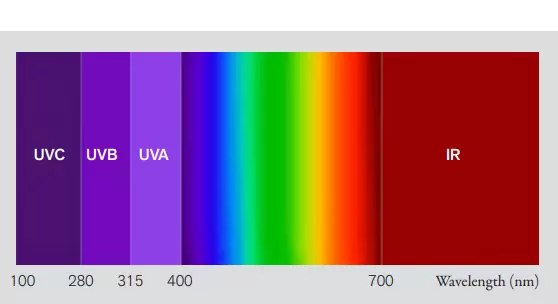
The color diagram (Fig. 1) shows the wavelength region from UV to NIR. The UV region is further differentiated between UV-A, UV-B and UV-C. This classification originates from the transmission of the gases in the atmosphere, UV-A showing the highest transmission.
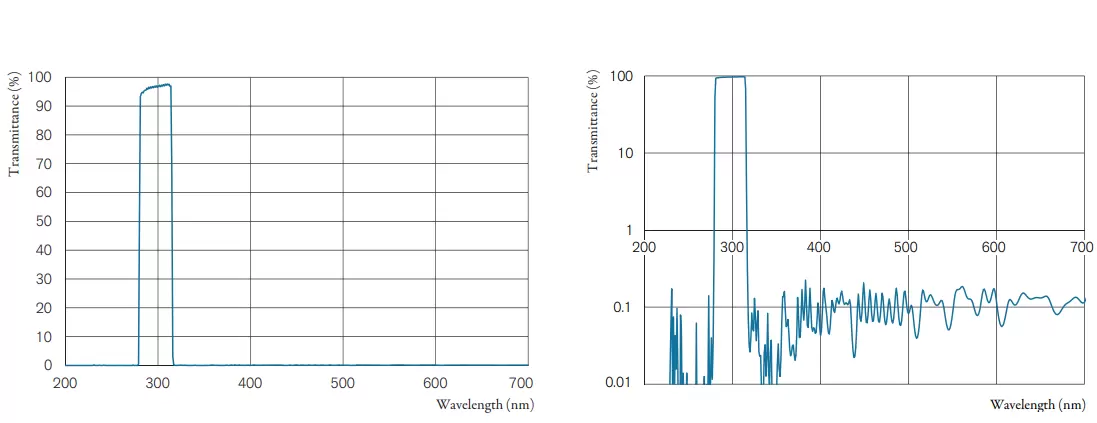
If you have an application where you only want to use a specific light band a custom filter can be designed which only transmits this wavelength region while the other bands are blocked. Exemplarily, the band pass filter in Fig. 2 shows a transmission only for UV-B light. The average transmission in the UV-band is larger than 95%. In the surrounding blocking region up to 700nm the average transmission is < 0.1% corresponding to an optical density of OD3 (1E-3). Such a filter can be used if you want to select only this wavelength band from a broadband light source and e.g. investigate the impact of UV-B light to the skin. Fully custom filters can be produced for a manifold of applications in analytics, science, space, semiconductor, industry, etc...The following examples shall give a rough idea about the range of possibilities.
In the following general characteristics of UV filters are discussed and several application examples given.
Fig. 1. Wavelength (color) scheme from UV to IR
Fig. 2. Filter design curve for selection of the UV-B band from 280-315 nm only. (left: linear scale, right: logarithmic scale)
Copyright: The information provided herein is correct to the best of Materion Balzers Optics knowledge. No liability for any errors, facts or opinions is accepted. Materion Balzers Optics disclaims any liability for incidental or consequential damages, which may result from the use of the product that are beyond its control. Nothing contained herein is to be considered as permission or a recommendation to infringe any patent or any other intellectual property right. All information contained herein is subject to change without notice. www.materionbalzersoptics.com
2/3
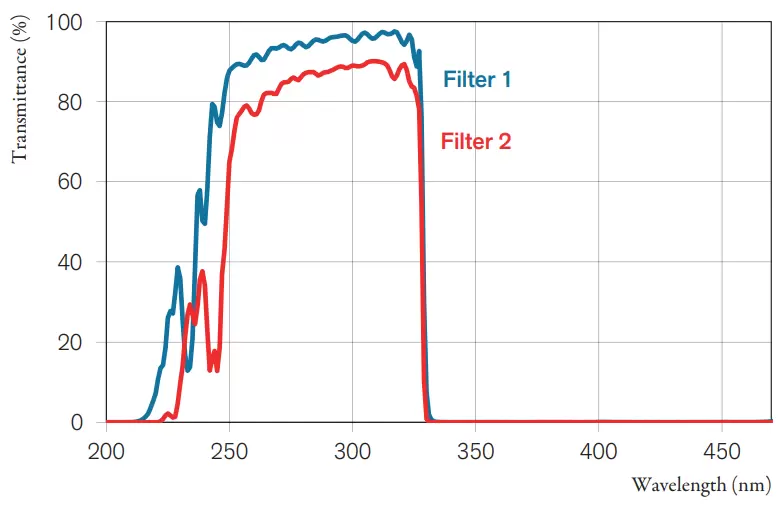
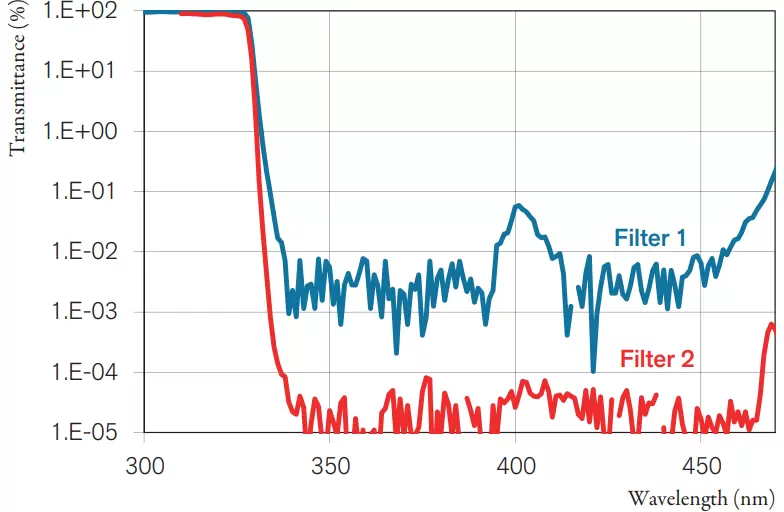
Fig. 3 compares the characteristics of two filters with different blocking width and depths in linear and logarithmic scale. For filter 2 the blocking is for a broader wavelength range and about 2 orders of magnitude deeper. For a wider and deeper blocking a filter design with more coating layers is needed. Accordingly, absorption as well as scattering increases at lower wavelength and the transmission gradually decreases from about 300 to 250nm. Generally, a thicker coating is accompanied by increased costs due to a longer duration of the coating process.
Fig. 3. Comparison of two UV bandpass filters with different blocking width and depth.
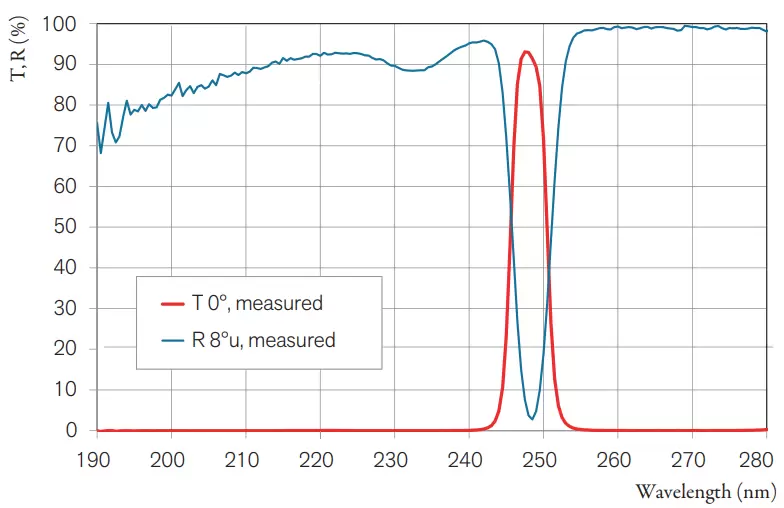
In Fig. 4 the feasibility of a narrow band pass filter is demonstrated, here at 248 nm. 248 nm is a typical Excimer laser wavelength. For cost-efficient applications a broadband UV light source combined with a bandpass filter at 248 nm has the potential to replace the excimer laser which is very complex, has a large footprint and high costs.
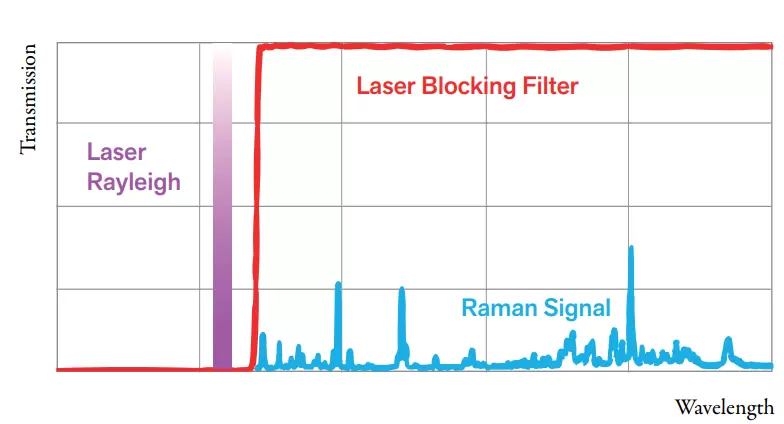
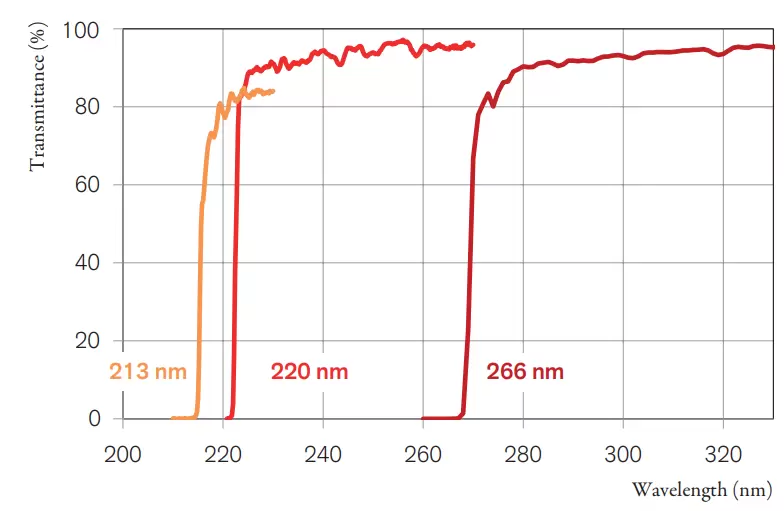
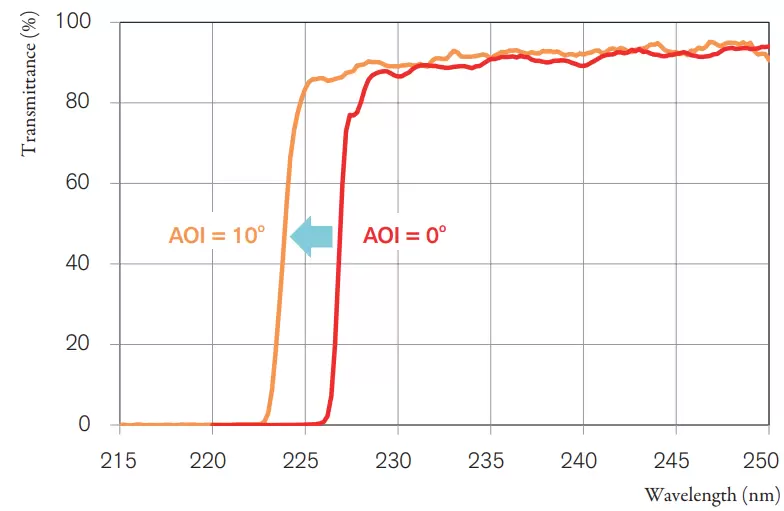
The next example shows the utilization of longpass filters in UV Raman spectroscopy. The filters must have very steep transmission edges in order to separate the low Raman signal from the strong scattered laser wavelength (Fig. 5). The transmission profiles for the longpass filters at 213, 220 and 266nm are displayed in Fig. 6. The diagram on the right demonstrates how the filter edges can be finetuned by changing the angle of incidence (AOI) on the filter.
Fig. 4. Narrow bandpass at 248 nm
Fig. 5. Schematic laser blocking filter in Raman spectroscopy.
Fig. 6. Transmission spectra of longpass filters with steep edges in UV Raman spectroscopy.
Copyright: The information provided herein is correct to the best of Materion Balzers Optics knowledge. No liability for any errors, facts or opinions is accepted. Materion Balzers Optics disclaims any liability for incidental or consequential damages, which may result from the use of the product that are beyond its control. Nothing contained herein is to be considered as permission or a recommendation to infringe any patent or any other intellectual property right. All information contained herein is subject to change without notice. www.materionbalzersoptics.com
3/3
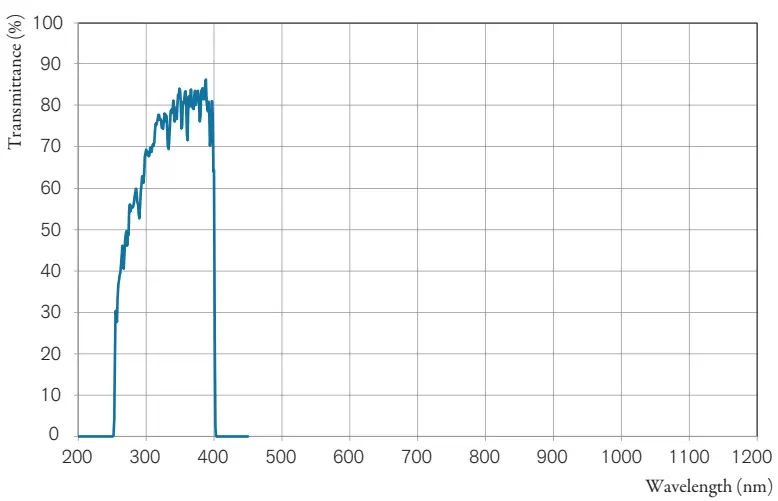
In Fig. 7 a very demanding UV bandpass filter with passband from 270-400 nm is displayed which was employed on the Mars Rover mission in 2020 (Fig. 8). Mars samples were analyzed in the UV region with strong blocking of environmental light from the sun in the VIS to NIR region up to 1200nm. Due to the wide spectral range from about 200-1200nm the filter design is very complex and consists of about 400 layers. A tight controlled, high-precision coating process is indispensable for production of such kind of filters.
Fig. 7. Bandpass filter 270-400nm with blocking up to 1200nm used on the Mars Rover mission 2020.
Fig 8. Mars Rover mission 2020
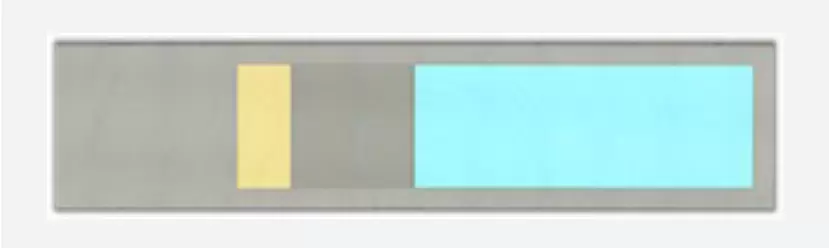
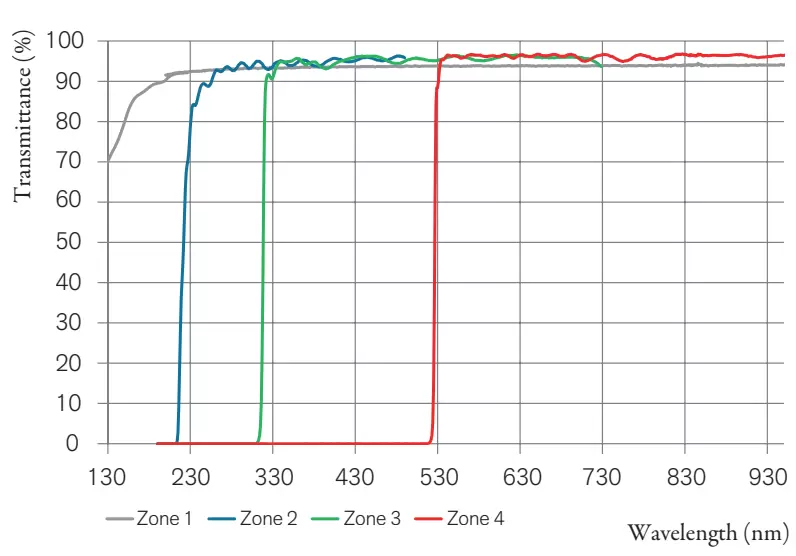
The last example in Fig. 9 shows a patterned filter which consists of 4 different regions and is used as an order sorting filter in UV spectroscopy: In grating-based spectrometers higher diffraction orders lead to artefacts in the measured spectra. These artefacts can be blocked by so called order sorting filters (OSF). Typically, such order sorting filters consist of one uncoated zone and two or three coated zones. The uncoated zone transmits the light with shortest wavelength whereas the coated zones are transmitting the longer wavelengths while blocking higher diffraction orders of shorter wavelengths. The individual transmission/filter profiles of the zones are displayed in Fig. 10. It is evident that zone 1 has a transmission in the UV-C range downto 130nm. This is realized by using crystalline CaF2 as a substrate instead of standard Fused Silica. Therefore the photolithographic structuring process was especially adapted to the sensitive nature of the CaF2 substrate material.
Fig. 9. OSF filter in the UV range on CaF2.
Fig. 10. Transmission spectra of the 4 different OSF zones on a CaF2 substrate.
Copyright: The information provided herein is correct to the best of Materion Balzers Optics knowledge. No liability for any errors, facts or opinions is accepted. Materion Balzers Optics disclaims any liability for incidental or consequential damages, which may result from the use of the product that are beyond its control. Nothing contained herein is to be considered as permission or a recommendation to infringe any patent or any other intellectual property right. All information contained herein is subject to change without notice. www.materionbalzersoptics.com