1/4
Application Note
MBO-AE-005 (2407-1)
Optics Balzers AG
Neugrüt 35
LI-9496 Balzers
T +423 388 9200
www.materionbalzersoptics.com
Materion Balzers Optics is a global leader in optical thin film coating solutions. We are the preferred partner for providing innovative optical coatings and solutions for over 70 years.
Author: Dr. Christian Katzer, Product Manager at Optics Balzers Jena GmbH, Jena, Germany
As early as 1672, Isaac Newton published the findings of his first basic experiments on the refraction of sunlight into its component colors using a prism, arguably setting the foundation for modern spectroscopy. Today, spectroscopic methods have significantly advanced and are being employed in a vast range of applications. For instance, modern spectrometers allow studying the unique “fingerprint” of light emitted or absorbed by different materials, giving us insight into the basic composition of substances. Other examples include biomedical applications like pharmaceutical quality control or Raman spectroscopy as well as fields like food quality control and waste sorting.
The dispersive element and issues associated with it
No matter what application, elemental to all spectroscopic applications is that a dispersive element is needed to separate the light into its component wavelengths. The dispersive element, which for Newton was a prism, spreads out these wavelengths spatially, allowing each wavelength to be analyzed individually. Nowadays, instead of prisms often diffraction gratings are preferred as a dispersive element due to their higher dispersion and their ability to cover a broad wavelength range. This allows for compact and lightweight designs which is especially beneficial in applications where portability is key.
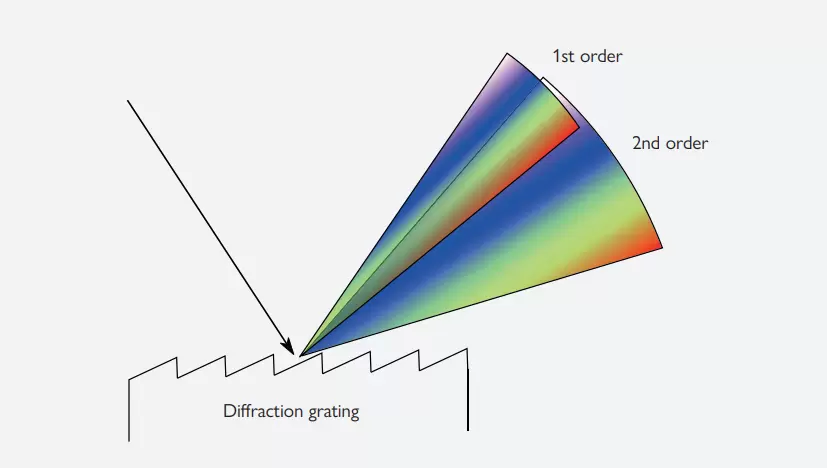
While gratings offer numerous advantages over prisms they do suffer from higher diffraction orders, especially when used in combination with broadband light sources (Fig. 1). When those higher-order spectra overlap with the first-order spectrum, it can become challenging to distinguish between genuine spectral features and those arising from interference between orders, complicating spectral analysis and requiring additional measures to cope with them.
Figure 1: In contrast to a prism, using a diffraction grating introduces higher orders which might overlap with the first-order spectrum.
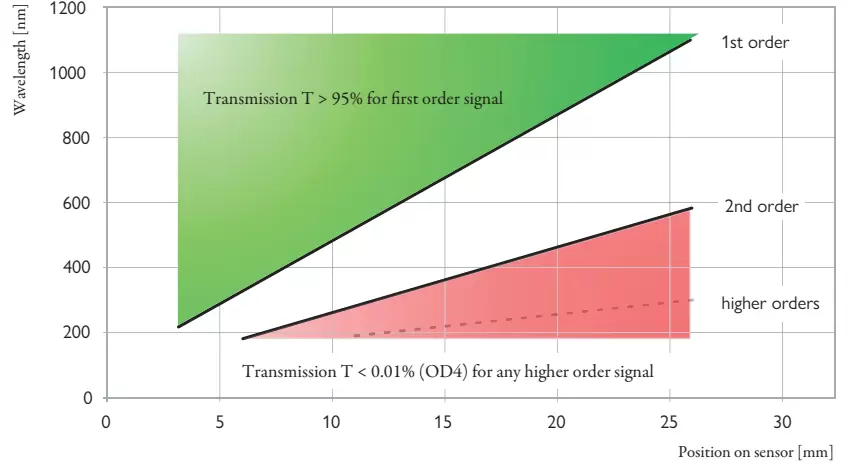
Figure 2: The component wavelength detected depends on the pixels’ position on the detector. At positions > 6mm the first order signal is superimposed by the second order. An ideal optical filter would transmit the first order spectrum while efficiently blocking all higher orders.
Copyright: The information provided herein is correct to the best of Materion Balzers Optics knowledge. No liability for any errors, facts or opinions is accepted. Materion Balzers Optics disclaims any liability for incidental or consequential damages, which may result from the use of the product that are beyond its control. Nothing contained herein is to be considered as permission or a recommendation to infringe any patent or any other intellectual property right. All information contained herein is subject to change without notice. www.materionbalzersoptics.com
2/4
Using order sorting filters to prevent overlapping diffraction orders
One method commonly employed to eliminate higher diffraction orders is to use optical filters which are placed directly in front of the detector. The ideal filter would allow transmitting the first order signal while efficiently suppressing any higher order with an optical density of OD4 or even higher (Fig. 2). While for spectrometers covering a narrow spectral range a simple longpass filter might suffice, broadband spectrometers often call for patterned multizone filters.
Figure 3: Classical order sorting filter consisting of individual zones, typically each having either a band- or a longpass performance.
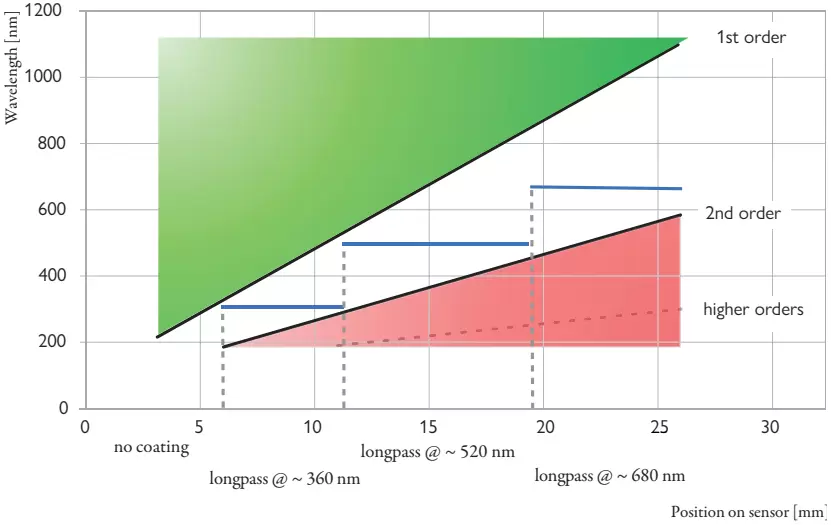
A typical spectrometer covering a spectral range between 190 nm and 1100 nm may, for example, employ an order sorting filter consisting of an uncoated region as well as three additional coated zones (Fig. 3). Optical filtering in these zones would typically be done using a set of longpass filters with different cut-on wavelengths (Fig. 4).
Figure 4: A broadband spectrometer calls for different longpass filters at different sensor positions.
Employing a photolithographic approach instead of assembling multiple filters next to each other allows achieving narrow transition widths of below 15µm between individual zones. While this width is typically sufficiently small, it could still potentially lead to issues. Ill-defined transition zones, for instance, may cause signal distortion, resulting in inaccuracies in the measured spectrum and affecting the reliability of the data. Additionally, any transition zone might contribute to spectral leakage, given the unclear definition of the filter's performance in this region.
The advantages of using a linear variable filter instead
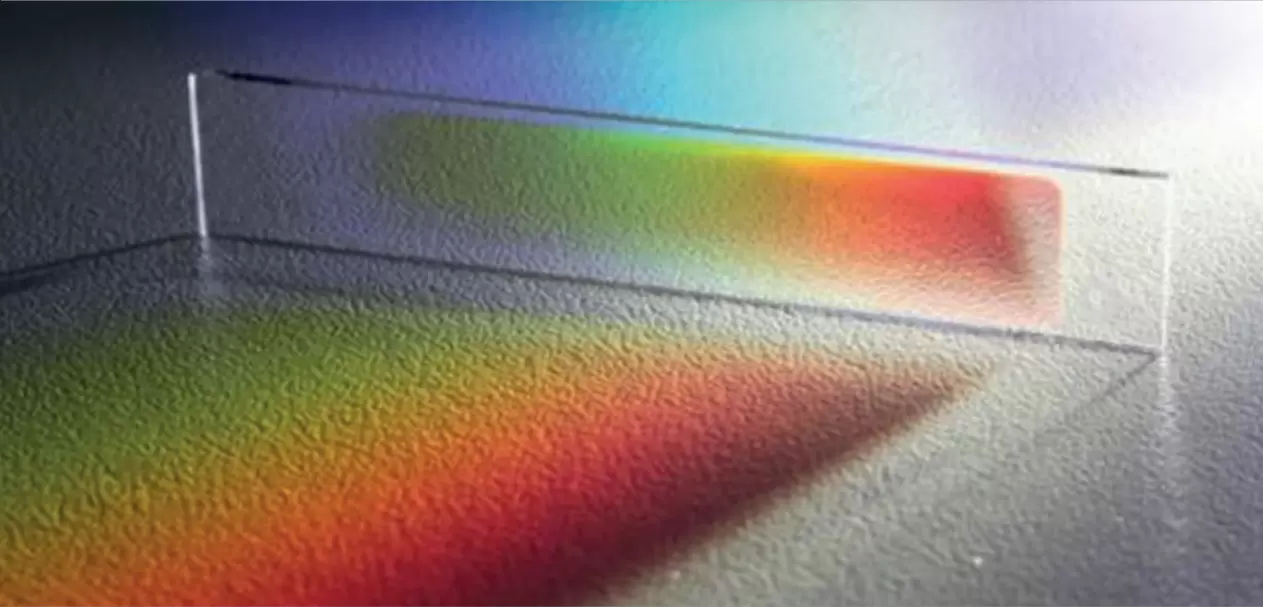
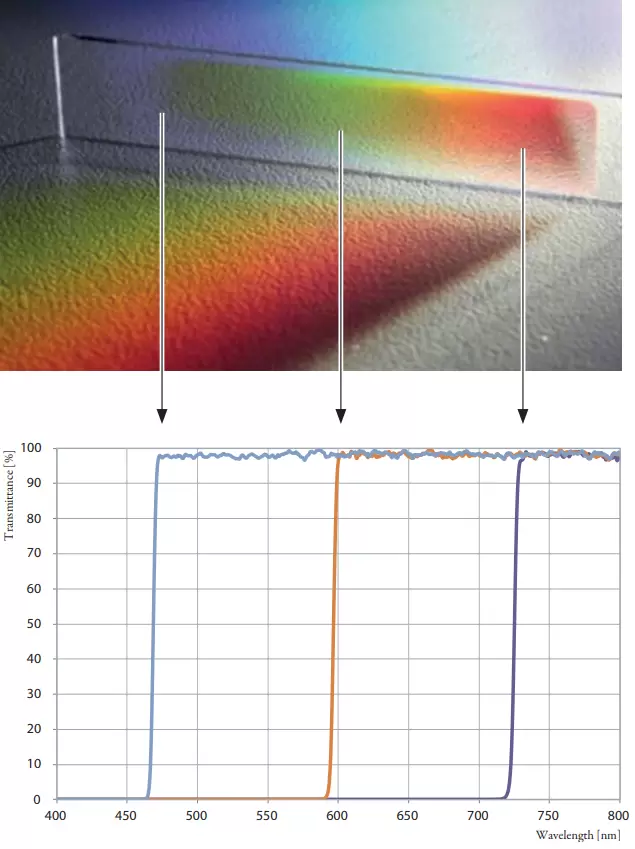
An elegant solution to surpass the aforementioned issues associated with transition zones is to use a linear variable longpass filter (LVF) instead. In contrast to a conventional multi-zone filter, LVFs provide a continuous and gradual variation in their spectral transmission across their surface, avoiding transition zones in the first place. Considering the LVF depicted in Figure 5, such a filter might transmit the whole visible spectrum on its one end, i.e. appearing “white” (left), while selectively allowing only the red spectrum to pass through on its other end (right). Since the cut-on wavelength of the linear variable longpass filter shifts continuously along the detector there is no need for using multiple filter zones with abrupt transitions in-between.
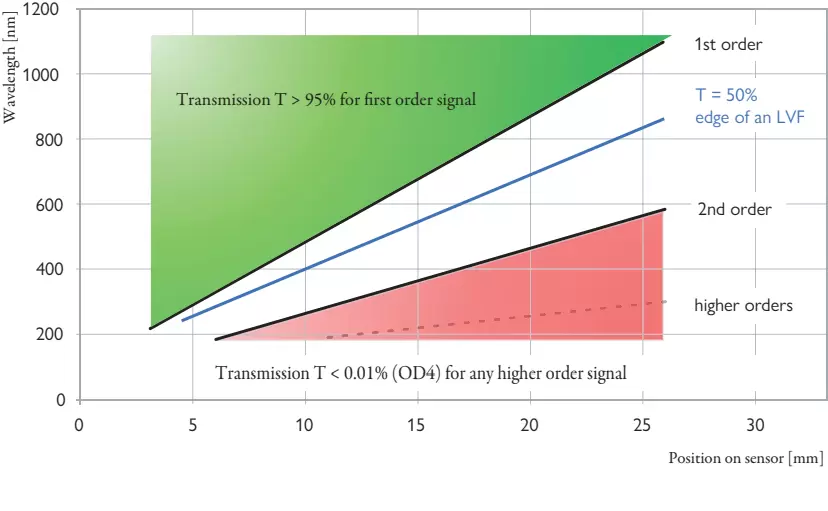
One important aspect to consider when employing LVFs instead of conventional order sorting filters is the dispersion or gradient. It describes how rapidly the spectral properties change as one moves along the length of the filter. A large gradient indicates that the spectral edge shifts rapidly over a short distance while a small gradient translates to a slower shift. As the dispersion of all LVFs provided by Materion Balzers Optics can be fully customized between 2nm/mm and more than 100nm/mm, they can fit almost all common detectors used in spectroscopic applications. Ideally, spectral range, layout and gradient of the LVF should be adapted to the sensor to position the 50% spectral edge between the first and second order signal (Fig. 6). This ensures that even under slight misalignment, no higher-order signals can be detected.
Figure 5: The spectral characteristics of LVFs depends on the position of illumination (measurement).
Copyright: The information provided herein is correct to the best of Materion Balzers Optics knowledge. No liability for any errors, facts or opinions is accepted. Materion Balzers Optics disclaims any liability for incidental or consequential damages, which may result from the use of the product that are beyond its control. Nothing contained herein is to be considered as permission or a recommendation to infringe any patent or any other intellectual property right. All information contained herein is subject to change without notice. www.materionbalzersoptics.com
3/4
Figure 6: Using a suitable linear variable longpass filter instead of a conventional order sorting filter, transition regions and any issues associated with them can be prevented.
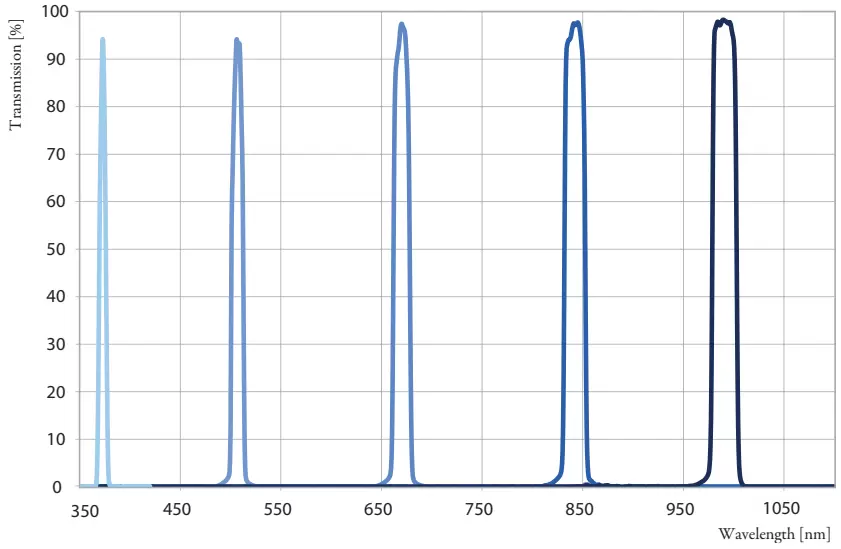
Typically, as for conventional order sorting filters, LVFs used for spectroscopy are often longpass-type filters like shown in Fig 5. Although less common, depending on the specific customers setup it may however sometimes be beneficial to use a bandpass-type filter like the one plotted in Fig. 7 instead.
Doing so might allow to reduce background noise by filtering out residual stray- or ambient light, leading to an improved signal to noise ratio. However, using bandpass filters may lead to higher costs due to their potentially more complex design requirements. Also, depending on its spectral width in terms of FWHM it might be more challenging to align a bandpass-type filter in front of the detector.
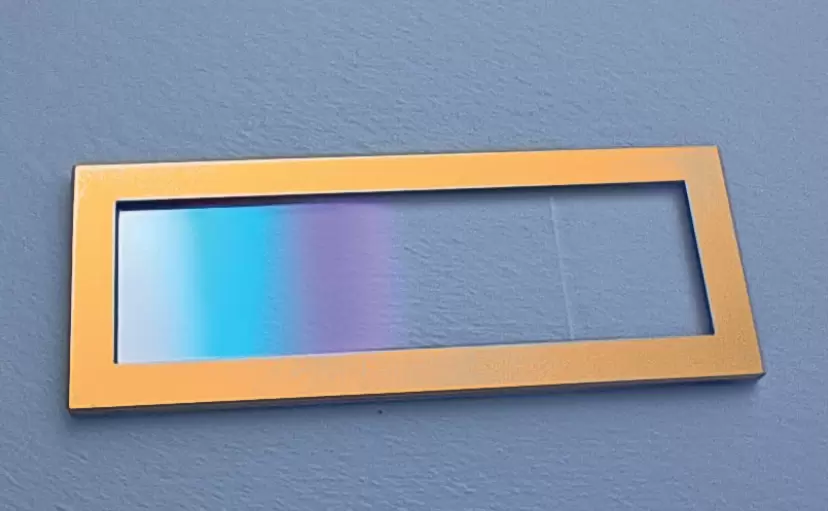
To suit the customers setup, all LVFs provided by Materion Balzers Optics can either be manufactured with their coating covering the whole length or, for UV applications, with an additional coating-free zone. On request, the substrates’ outline can also be covered with MBO’s renowned GelotTM coating to allow for a seamless and hermetic sealing directly in front of the detector (Fig. 8). GelotTM is a solderable gold-based multilayer coating suitable for all common soldering techniques.
Figure 7: Linear variable bandpass with a spectral width of 2% and a blocking power of OD5. The center wavelength shifts from 360 nm to 1000 nm when moving across the filter.
Figure 8: On request, all filters may be combined with Materion’ s solderable GelotTM coating for hermitically sealing the detector.
The unique selling points of Materion Optics Balzers’ LVFs
Materion Optics Balzers (MBO) is a world-renowned designer and manufacturer of bespoke precision optical thin-film coatings and components, operating across the entire electromagnetic spectrum to serve an extensive range of applications and industries.
When it comes to LVF technology, MBO is at the forefront, with a number of unique features that set its filters apart. Unlike conventional LVFs, MBO's filters can be manufactured using plasma-assisted reactive magnetron sputtering. This cutting-edge coating process provides low absorption, providing better spectral transmission properties. Depending on the wavelength, transmissions of up to 97% can be achieved, allowing users to benefit from an increased sensitivity. The sputter technology also ensures high durability and excellent long-term stability of the filters.
Materion Balzers Optics' LVFs allow for even the most complex designs, with hundreds of individual layers made possible. This capability ensures an exceptional rejection of unwanted light, reaching optical densities of up to OD8.
The gradient, or spatial dependence of the spectral function, can be tailored to customer specifications. For conventional fluorescence analyses, gradients of 5–15 nm/mm may be required, while hyperspectral applications or miniaturized spectrometer might demand gradients of up to 100 nm/mm or more. MBO's LVFs provide the versatility to meet these diverse current and future needs.

Copyright: The information provided herein is correct to the best of Materion Balzers Optics knowledge. No liability for any errors, facts or opinions is accepted. Materion Balzers Optics disclaims any liability for incidental or consequential damages, which may result from the use of the product that are beyond its control. Nothing contained herein is to be considered as permission or a recommendation to infringe any patent or any other intellectual property right. All information contained herein is subject to change without notice. www.materionbalzersoptics.com
4/4
Linear Variable Filters offer a cost- and space- efficient alternative to classical, multi-zone coated optical filters for order sorting thanks to their versatility and spectral characteristics, but it is essential to select the right partner to ensure that you are equipped with exactly the right filter for your project.
With more than 100 years of experience in optics and materials science, and facilities across the US, Europe and Asia, Materion Balzers Optics is able to efficiently react to continually shifting market trends while addressing the ever-evolving demands of its customers. Expert engineers are on hand to push the boundaries of advanced optical components, helping customers stay on the cutting edge in their markets.
Find out more information about how Materion Optics Balzers can help you find the right LVF for your spectrometer by visiting:
www.materionbalzersoptics.com
Copyright: The information provided herein is correct to the best of Materion Balzers Optics knowledge. No liability for any errors, facts or opinions is accepted. Materion Balzers Optics disclaims any liability for incidental or consequential damages, which may result from the use of the product that are beyond its control. Nothing contained herein is to be considered as permission or a recommendation to infringe any patent or any other intellectual property right. All information contained herein is subject to change without notice. www.materionbalzersoptics.com