Photonics is considered to be one of the key enabling technologies for many attractive applications. For almost all photonic devices, optical coatings are key components to tailor the spectrum specifically for each application. A wide variety of requirements exist in this field, like e.g. filter(arrays) with very small dimensions, high transmission UV filters with deep absorption free blocking close to the transmission wavelength, broad band absorption free and high reflection or miniaturized polarizing beam-splitters, which need to be manufactures cost effectively in high volumes.
This paper presents a selection of optical key components and the specific spectral requirements of the optical coatings including their applications.
Keywords: micro-patterned optical filters, broad band high and absorption free reflection, UV filters, miniaturized polarizing beam splitters
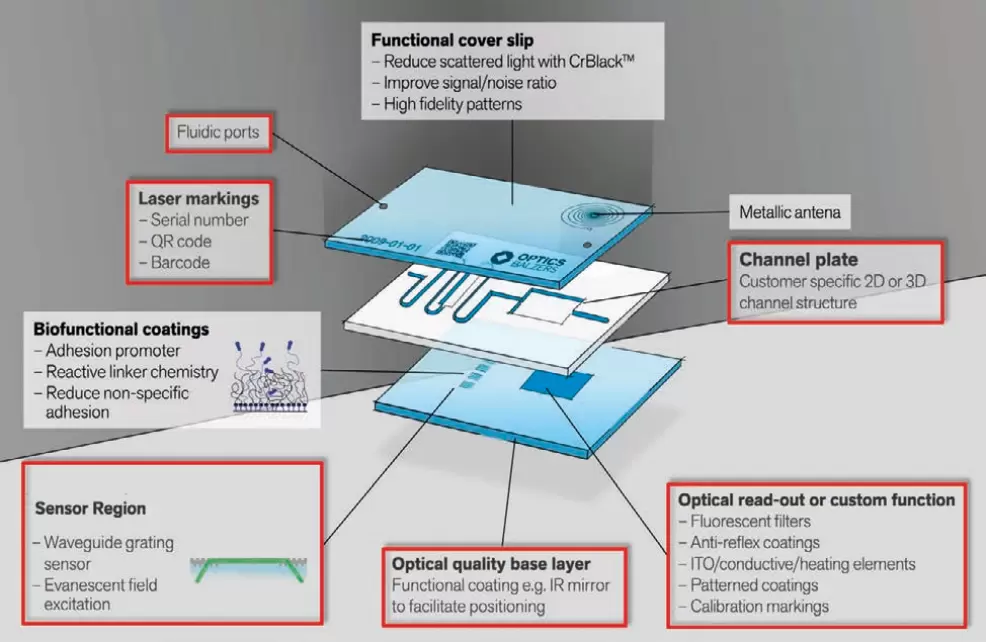
FIGURE 1: Customized functions integrated on a biochip substrate.
Biochip applications are extremely diverse. They can be used for e.g. for gene sequencing as well as for water quality monitoring or food screening (e.g. pesticide residues detection, genetically modified food detection etc.). Each chip is developed with a clear focus on the particular user needs. The substrate selection is one of the most critical decisions when designing a new biochip and depends strongly on the application. Substrates must be low cost, inert as far as possible, uniform in terms of surface properties and the material must be suitable for the integration of customized features. For glass substrates e.g. patterned chrome might apply, fluorescence filters, conductive coatings, laser markings or channel structures as shown schematically in Fig. 1.
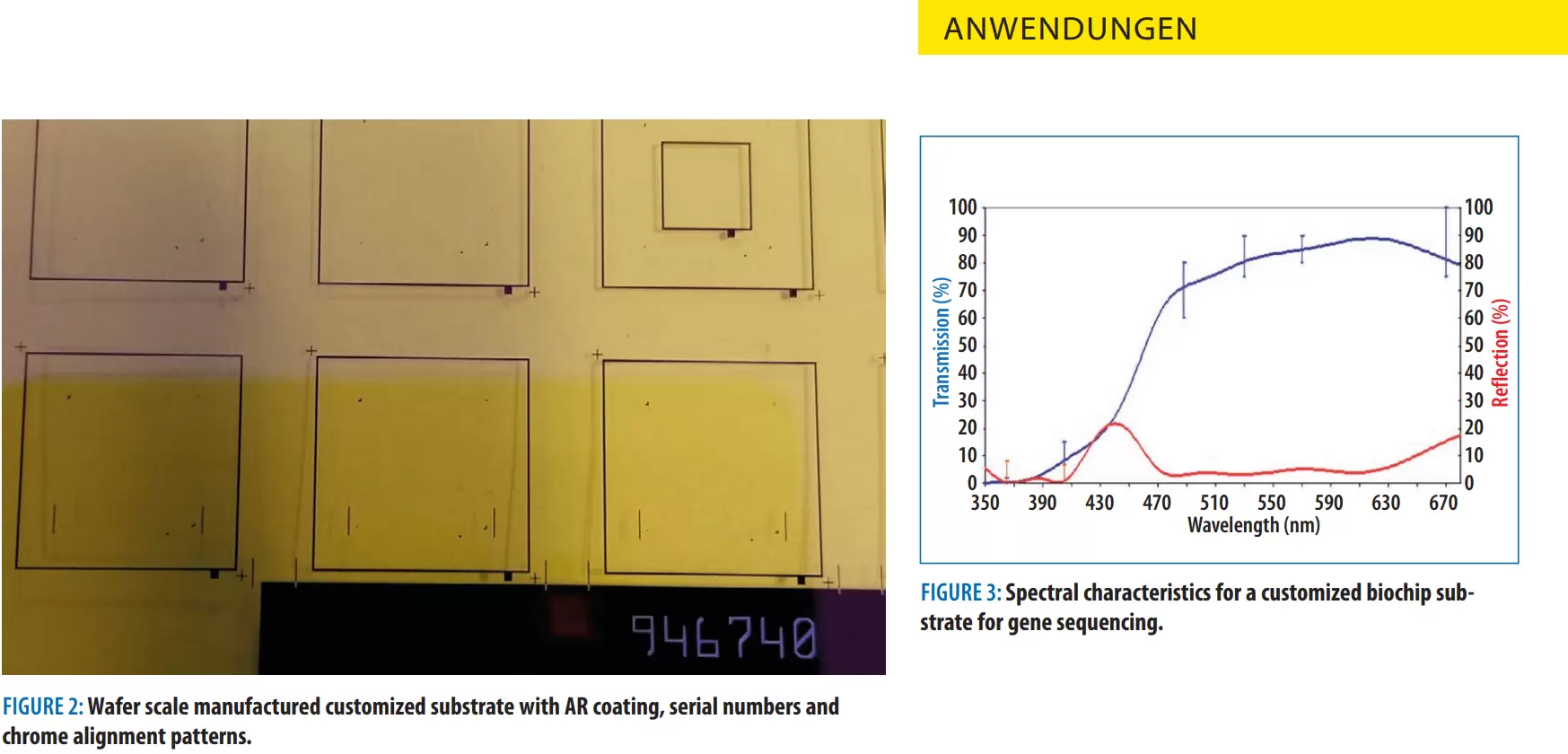
Fig. 2 for example shows a customized biochip substrate, which is the basis for a gene-specific probe. For the manufacturing process of this chip a high absorption is needed at 365 nm and 405 nm to eliminate disruptive fluorescence from the glass
substrate and multiple reflections from its surface.
To make an effective fluorescence analysis possible, the transmission is required to be maximized for the excitation wavelengths 488 nm and 532 nm and the emitted wavelengths at 570 nm, 590 nm and 670 nm. The spectral characteristic including the required transmission is shown in Fig. 3.
Additional features requested by the customer are individual serial numbers on each wafer and chrome patterns used for chip alignment (see Fig. 2)
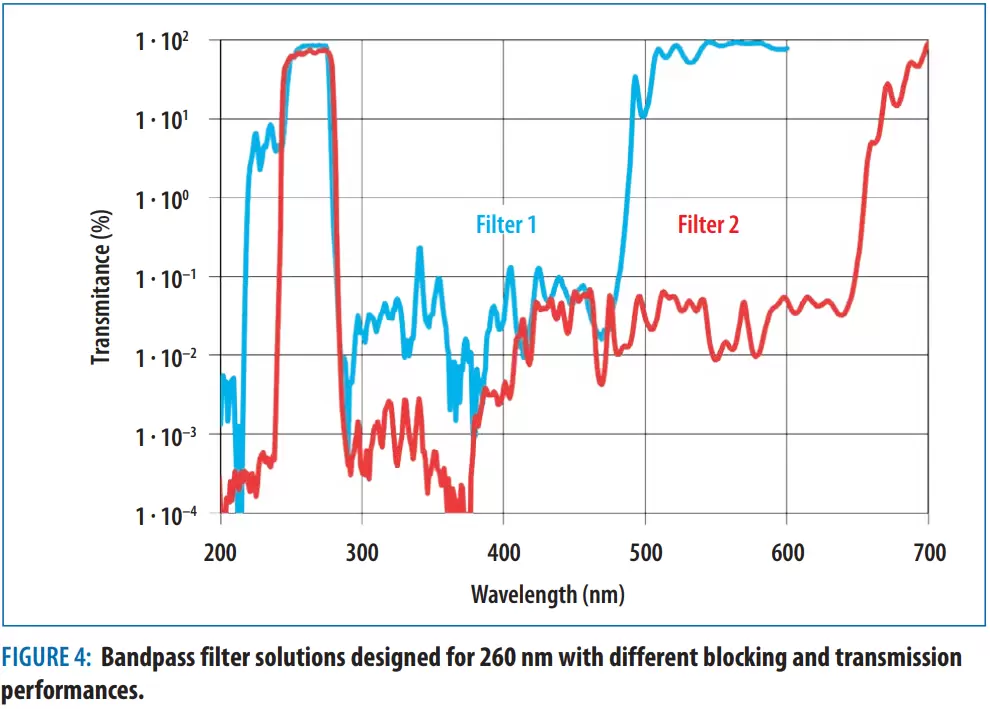
For wafer inspection UV-light is used to reliably detect contaminations as it provides bright contrast. Since the size of the integrated circuit patterns continuously decreases, the minimum particle size required to be detected became also smaller (< 20 nm) and hence the required illumination wavelength also decreases. Typically the illumination wavelength is required to be well defined and high power illumination sources like mercury arc lamps
are used. These illumination conditions generally require high transmission (> 90 %) narrow bandpass filters (FWHM < 5 nm) and an effective blocking (~OD 5) around the transmission wavelength. This blocking is required to be achieved by dielectric materials only, to minimize absorption and consequently extensive heating, leading to a possible destruction of the filter component. In Fig. 4 two bandpass filter solutions designed for 260 nm are shown as examples. Filter 1 with a transmission of 88% was designed with a standard blocking OD3 up to 480 nm. Filter 2 compromises the transmission (max. 75 %) but allows for a deeper blocking of OD5 around the transmission band and OD3 up to 650 nm. Deep and broadband dielectric blocking requires a high number of layers. Therefore the filter 1 and filter 2 consist of 130 and 200 layers which sum up to a coating thickness of 7 µm and 12 µm respectively. Transmission and blocking performance is a typical tradeoff and needs to be balanced according to customer requirements.
This contribution discusses a choice of high-precision interference coatings which are customized for specific applications in different photonic marketplaces:
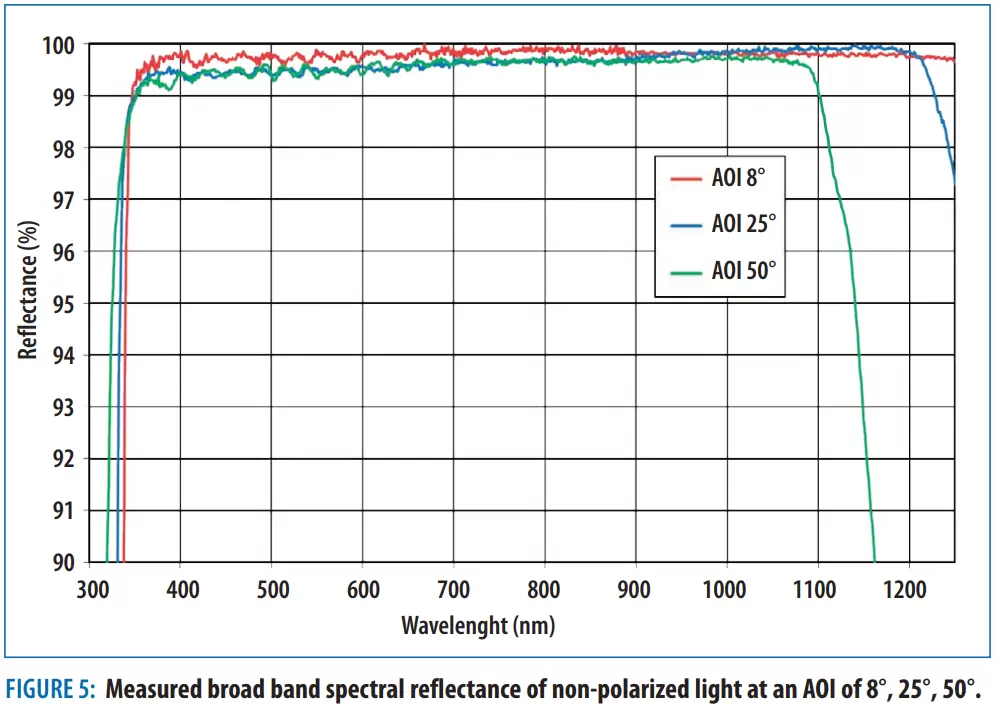
Broadband dielectric mirrors are characterized by a reflectivity of > 99 % covering a wavelength range between 320 nm to 2000 nm and by a wide acceptance range for the angle of incidence (0°–50°). Absorption losses are minimized as far as possible by using dielectric layer materials only. The absence of any metal layers in the coating minimizes corrosion and qualifies this filter for use in harsh and humid environments. When used for a white reflectance standard, its excellent mechanical durability allows the filter to be cleaned repeatedly.
These mirrors are frequently used in experimental setups which require a flexible application of different wavelengths. The wide reflectance range e.g. allows using a pilot laser to adjust the optical setup and simultaneously the actual application wavelength of a different light source.
As an example Fig. 5 displays a customized mirror with a consistently high and broad band reflectance between 350 nm and 1100 nm at an angle of incidence (AOI) of 8°, 25° and 50° respectively. This mirror demonstrates the almost unaffected high reflectance and the change of the reflectance bandwidth in the indicated angle range.
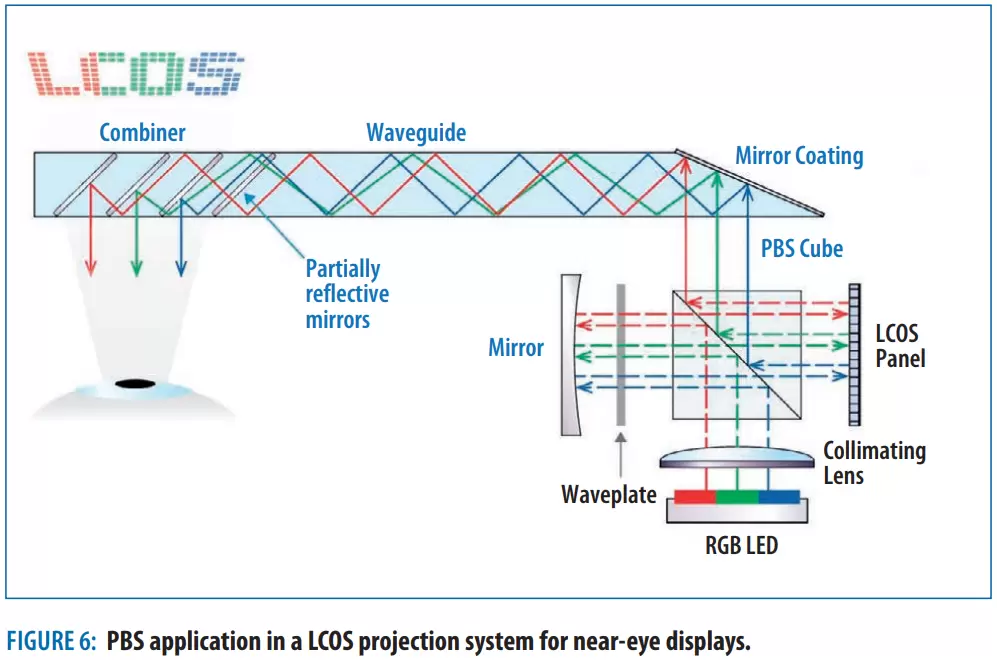
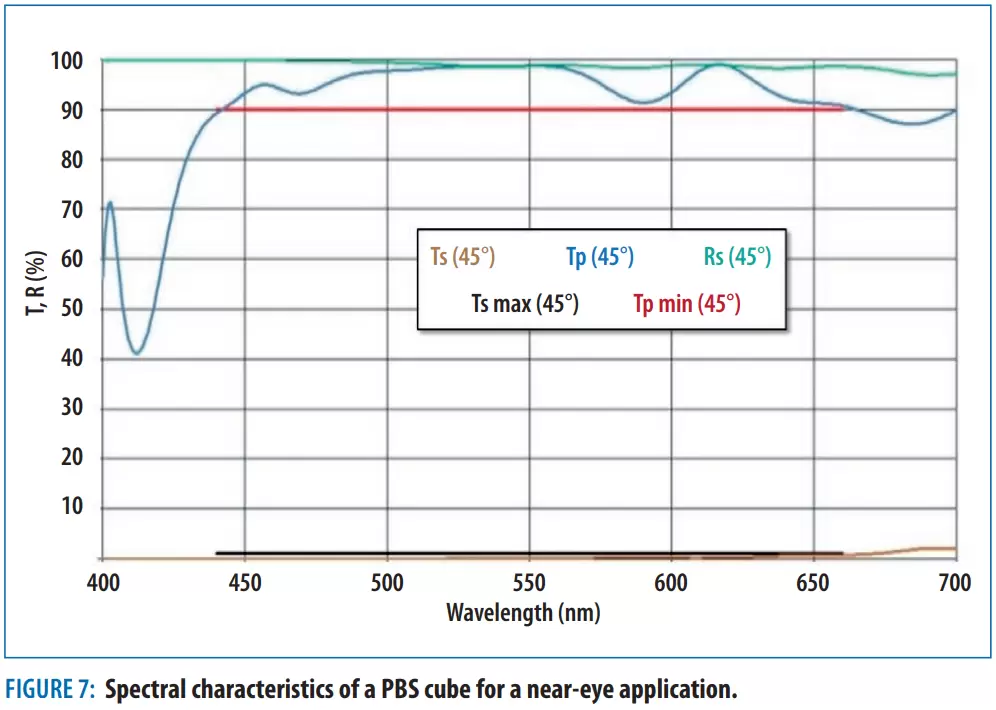
Miniaturized projection systems like near eye displays, as shown schematically in Fig. 6, are driving the need for advanced and miniaturized polarizing beam splitter (PBS) cubes. In order to achieve an optimum light throughput any non-functional area on the optical surfaces must be eliminated by applying an edge to edge coating technology, for the PBS coating as well as for the AR coatings on the outer cube surfaces. Some customized cube designs also require patterned or uniform black chrome coatings to reduce unwanted scattered light. Fig. 7 shows the transmitted spectra of the s- and p-component of a PBS cube for a near eye application as well as the reflected s-component at 45° between 440 nm and 660 nm. Ts was requested to be < 0.7 % within this wavelength range while Tp was required to be > 89 %. Hence a separation ratio for the polarization Tp (min.)/ Ts (max.) of 127 was achieved. Typically the separation ratio needs to be as high as possible for an angle range of 45° ± 10°. In this solution Ts < 4 % and Tp > 78 % was achieved for 35° between 440 nm and 660 nm (Tp (min.) / Ts (max.) = 19). To achieve these spectral requirements it is obviously a key to minimize any absorption losses. The total coating stack consists of 62 layers and sums up to a total thickness of 4.8 µm. A high number of layers are thinner than 30 nm and the thinnest layer is just 10 nm thick. Therefore stable deposition processes must be optimized in particular to reduce losses caused by interface absorption.
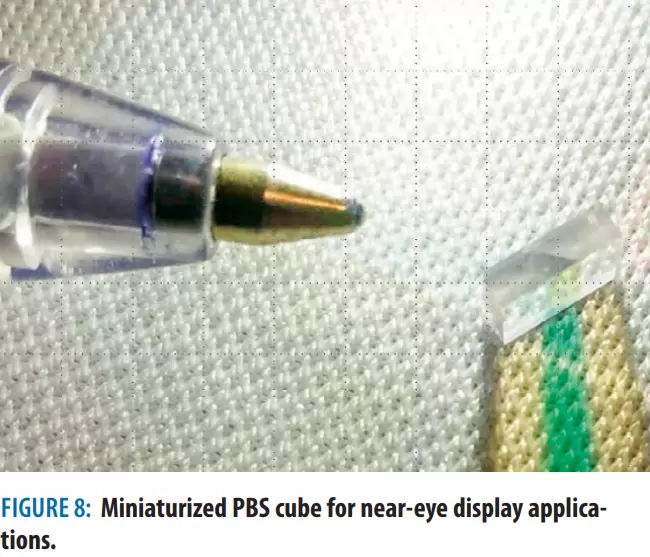
As near eye applications are considered to be future consumer products, the component sizes need to be minimized as shown in Fig.8 and the manufacturing process must be designed to be suitable for cost effective high volume production.
Aktuelle Entwicklungen auf dem Gebiet hochpräziser optischer Schichten
Dieser Beitrag behandelt eine Auswahl von hochpräzisen Interferenzschichtsystemen, die an spezifische Anwendungen in verschiedensten Märkten angepasst sind:
Four specific optical coating solutions were presented in this contribution. Each of them represents a key component in a photonics application like in biochip substrates, in UV- microscopy, near-eye displays or broadband low loss reflection. All these coatings and the associated deposition processes were designed and developed in close
cooperation with the customers to optimize the function for the specific application requirements. Close customer relationship, design and process competence in optical coatings combined with a solid experience in optical assemblies mass production makes further attractive photonic marketplaces accessible, e.g. the automotive and aviation sectors as well as the medical or lighting markets.
Dr. Marcus Frank
Studium der Physik an der Friedrich-Alexander-Universität Erlangen. Promotion zum Dr. rer. nat. an der Friedrich-Schiller-Universität in Jena. Wissenschaftlicher Mitarbeiter in der Abteilung “Optische Schichten” am Fraunhofer Institut für Angewandte Optik und Feinmechanik (IOF) in Jena. Produkt- und Prozessentwicklung im Bereich der Architekturglasbeschichtung für arcon (Feuchtwangen, Deutschland) und Guardian Science and Technology Center(Michigan, USA). Seit 2015 Leiter der Abteilung Business Development bei der Optics Balzers AG.
Dr. Marcus Frank, Optics Balzers AG,Balzers, Neugrüt 35, LI-9496 Balzers, Liechtenstein; marcus.
Turn on Javascript!