Author: Dr. Christian Katzer, Product Management, Materion Balzers Optics
Fluorescence imaging is a widely popular method of molecule analysis in chemistry, biochemistry, and medicine, thanks to properties such as elevated sensitivity, enhanced specificity, simplicity in comparison to many alternative microscopic techniques, and the versatility to be used in living cells and organisms.
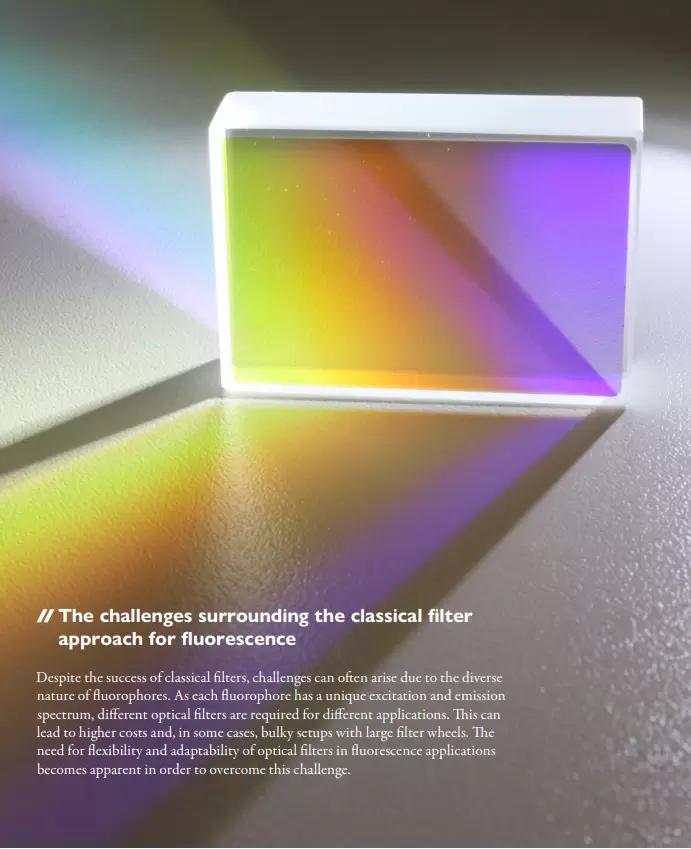
Despite the success of using classical optical filters in fluorescence applications, challenges can often arise due to the diverse nature of fluorophores. As each fluorophore has a unique excitation and emission spectrum, different optical filters are required for different applications, which can lead to higher costs. This White Paper looks at linear variable filters (LVFs) as an alternative to more classical filters, and details their advantages compared to homogeneous filters.
01 White paper / MBO-001-WE (2401-01) / © by Materion Balzers Optics

Fluorescence is the physical phenomenon of absorbing light and subsequently emitting it in a different colour, with the emitted light’s colour possessing a higher wavelength than the absorbed one. Molecules or substances showing this effect are often called fluorophores.
Fluorescence enables a number of applications across chemistry, biochemistry, and medicine. While in our everyday life it may be most commonly seen in fluorescent lamps, it has also found its technical applications in chemical sensors, mineralogy and especially microscopy.
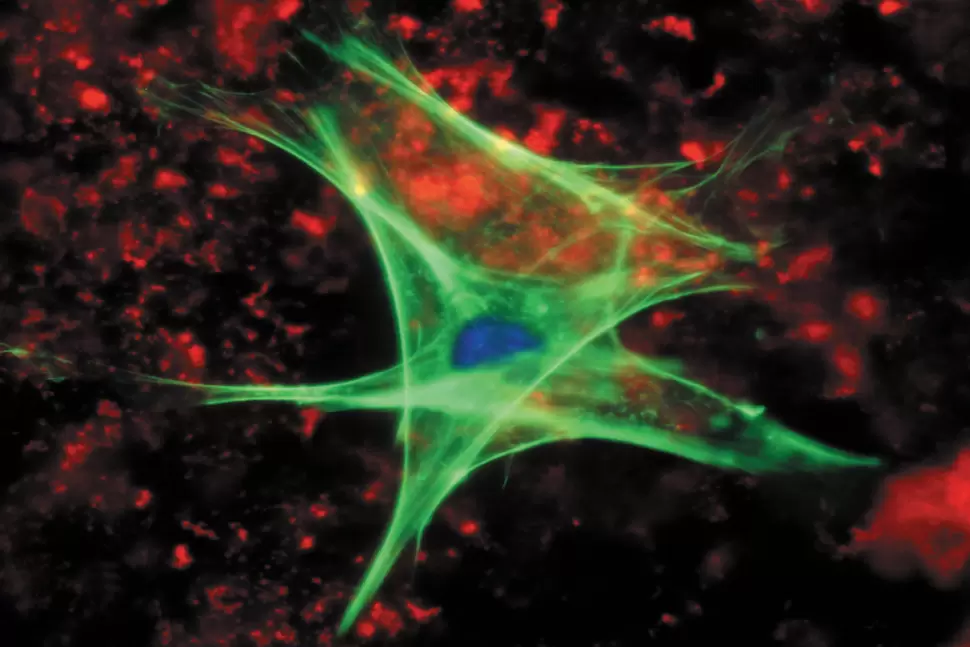
High-resolution microscopy often utilizes fluorescent dyes to reveal specific structures in biological samples. More specifically, a sample can be labelled with a fluorescent dye, which attaches to a specific target structure, such as proteins or DNA. By illuminating the sample with an appropriate spectrum, given by the fluorophore used, the labelled structures absorb light and emit their fluorescence response. This allows researchers to highlight target structures in images (figure 1), which could aid the examination of subcellular structures and processes in living cells. By simultaneously using different fluorescent dyes, researchers can simultaneously investigate and colour code various cell components and molecules.
Figure 1: Fluorescence microscopy image of a cell
02 White paper / MBO-001-WE (2401-01) / © by Materion Balzers Optics

Optical filters are vital in fluorescence experiments since the exciting light often is much more intense than the fluorescence response and needs to be avoided during detection. Apart from separating excitation and emission spectra, optical filters are also used for reducing background interference, minimising photobleaching, improving signal-to-noise ratio, enhancing specificity and sensitivity, and optimising image contrast.
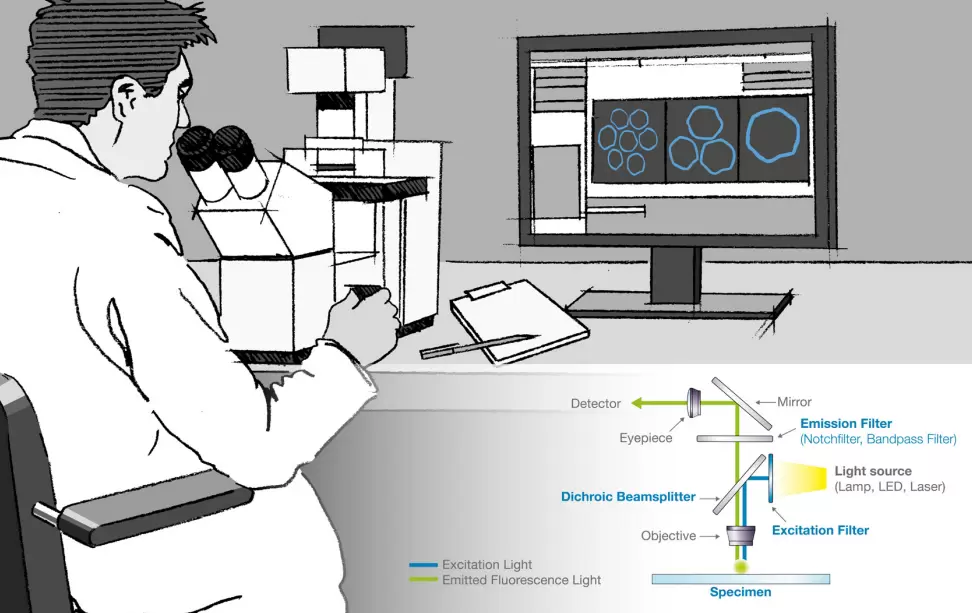
The classical optical filter set up for fluorescence imaging generally consists of three filter types: excitation filters, emission filters, and dichroic filters (Figure 2, inset).
While excitation filters selectively transmit the specific spectrum needed to excite the fluorescent dye, blocking light in other wavelength ranges, emission filters exclusively transmit the emitted fluorescence response, while blocking both the excitation light and background light. Dichroic filters reflect excitation light and transmit the emitted fluorescent spectrum.
Figure 2: Simplified beam path in fluorescence microscopy
03 White paper / MBO-001-WE (2401-01) / © by Materion Balzers Optics
04 White paper / MBO-001-WE (2401-01) / © by Materion Balzers Optics

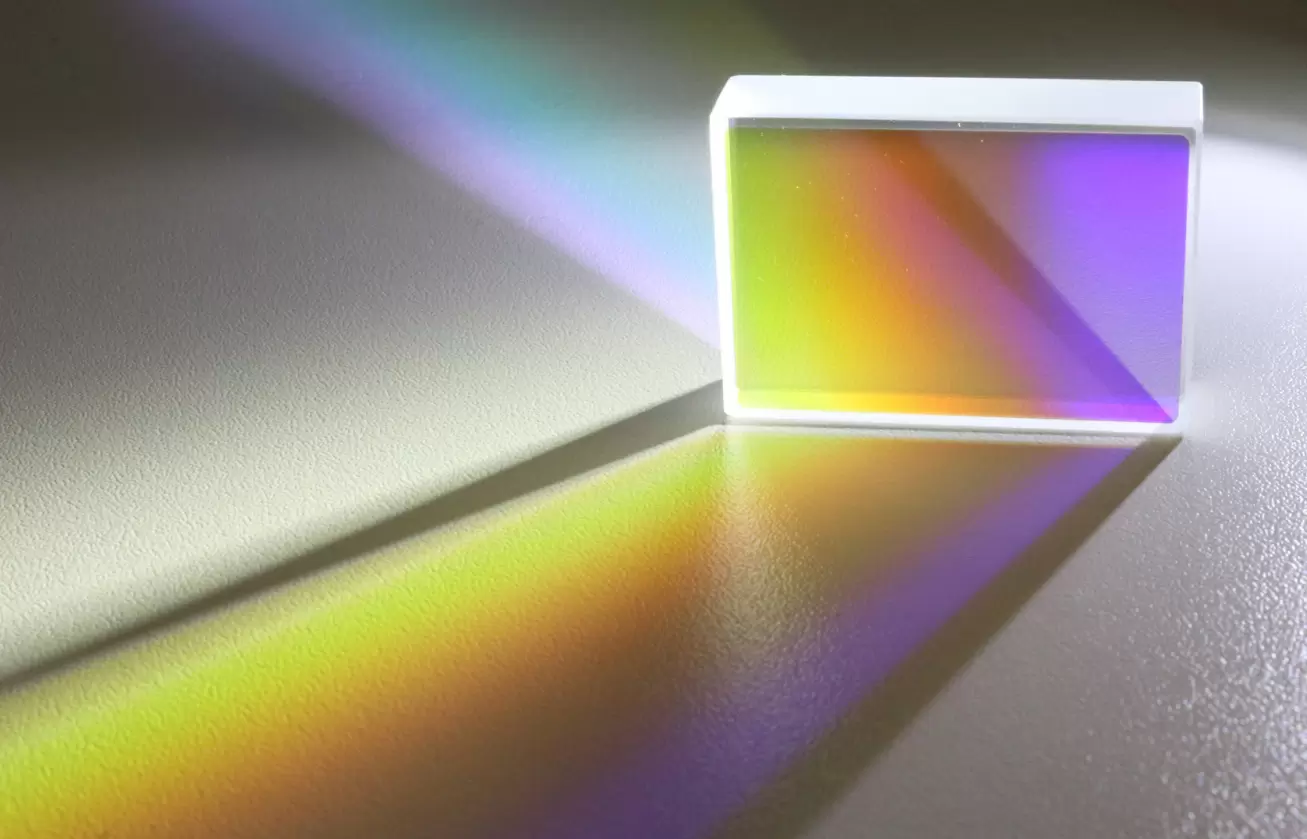
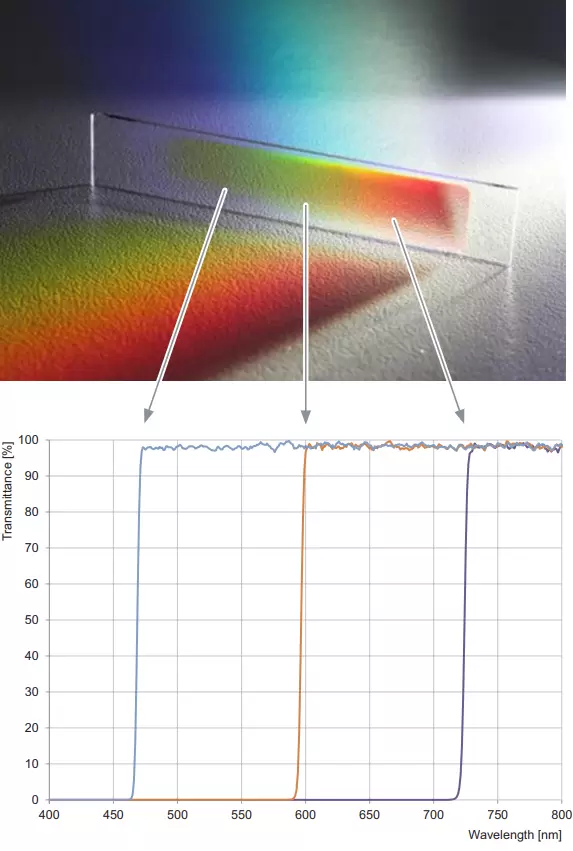
In contrast to conventional optical filters, which exhibit distinct transmission and blocking bands uniformly across their whole surface it is also possible to use so called Linear Variable Filters (LVFs). LVFs provide a continuously variable transmission characteristics across their surface. Considering the LVF depicted in Figure 3, such a filter might transmit the whole visible spectrum on its one end, i.e. appearing “white” (left), while selectively allowing only the red spectrum to pass through on its other end (right). Users can adjust their required transmission characteristic simply by altering the position of illumination on the filter, winning more flexibility. LVFs especially excel in applications requiring precise wavelength control such as spectroscopy and hyperspectral imaging. They should also be considered when it comes to sophisticated optical setups requiring multiple wavelength bands like in fluorescence applications.
Figure 3: The spectral characteristics of LVFs depends on the position of illumination (measurement).
05 White paper / MBO-001-WE (2401-01) / © by Materion Balzers Optics
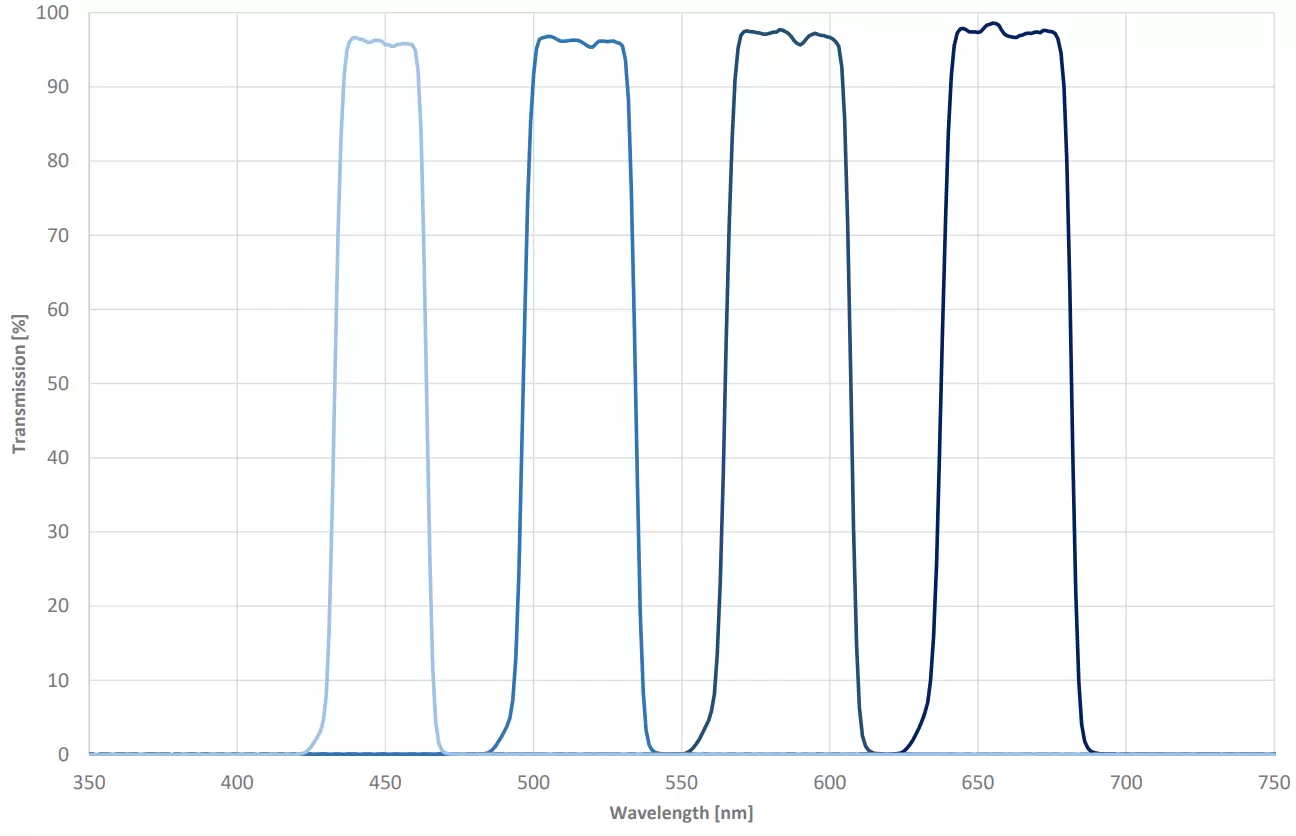
In fluorescence applications, conventional excitation and emission filters are often designed as bandpass filter type. If one wishes to replace both filters with linear variable ones, a straight-forward solution to do so would be to use a bandpass type LVF as well (Figure 4). The centre wavelength (CWL) of such a filter would depend on the position at which the light passes the filter. Consequently, instead of changing different filters in the setup, a simple translation stage could suffice to adapt the system to a different fluorophore.
While this solution could function effectively and prove more versatile than employing multiple excitation and emission filters, it falls short of realizing the full potential. Although the CWL of a linear variable bandpass can be adjusted by altering the illumination position, individually addressing its spectral width (FWHM) is impossible. However, in the scenario of transitioning to a different fluorophore, it might be necessary to modify the FWHM as well to optimize results.
Figure 4: Linear variable bandpass filter measured at four different lateral positions on the substrate.
06 White paper / MBO-001-WE (2401-01) / © by Materion Balzers Optics
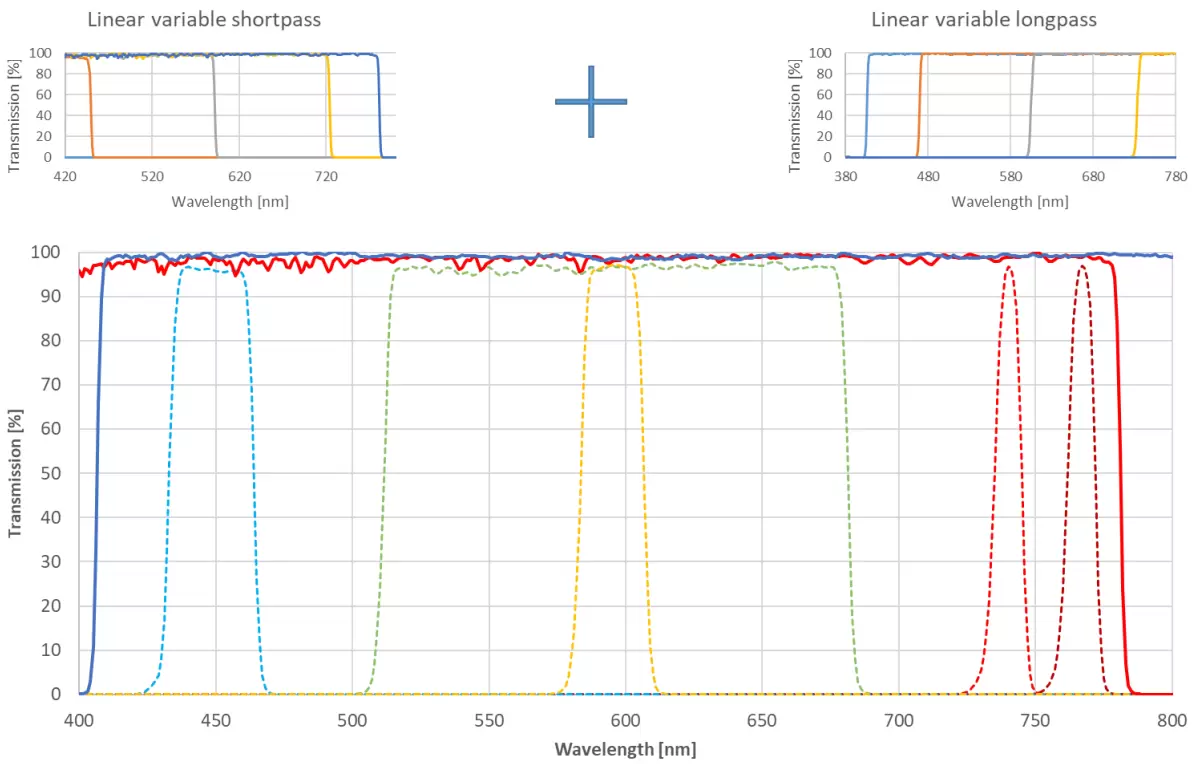
The preferred solution would be to use a combination of two LVFs – one being a linear variable shortpass and the other one being a linear variable longpass. By placing both LVFs behind each other, a flexible bandpass is formed with its centre wavelength and spectral width being individually adjustable. Simultaneously sliding both filters in parallel to each other in the beam path would allow tuning the centre wavelength while leaving its spectral width constant. Conversely, tuning the FWHM could be achieved independently by sliding both filters with respect to each other. For a short video explanation, one might refer to the Materion Balzers Optics Website (https://youtu.be/PCs1Gizz78Y).
Utilizing this approach allows for specifically tailoring the resulting bandpass to the application’s requirements. The accessible wavelength range would be defined by the long pass filter’s longest cut-on wavelength and the short pass filter’s shortest cut-off, respectively. To visualize this, Figure 5 depicts several bandpass characteristics, all obtained by sequentially combining the two LVFs shown on top. Hence, using a twoLVF approach instead of conventional, homogeneous excitation and emission filters allows for much more versatile fluorescence setups, making it easy to transition to a different fluorophore. This might also help to reduce the overall dimensions and cut cost, as the need for multiple, different excitation and emission filters is eliminated.
Apart from the discussed long-, short and bandpass designs of LVFs, on request, they are also available as notch or dichroic type.
Figure 5: Sequentially combining a linear variable short- and linear variable longpass allows obtaining a versatile bandpass characteristic. Dashed curves were measured using various combinations of the two LVFs shown on top.
07 White paper / MBO-001-WE (2401-01) / © by Materion Balzers Optics

Materion Optics Balzers is a world-renowned designer and manufacturer of bespoke precision optical thin-film coatings and components, operating across the entire electromagnetic spectrum to serve an extensive range of applications and industries.
When it comes to LVF technology, Materion Optics Balzers is at the forefront, with a number of unique features that set its filters apart. Unlike conventional LVFs, Materion’s filters can be manufactured using plasma-assisted reactive magnetron sputtering. This cutting-edge coating process provides low absorption, providing better spectral transmission properties. Depending on the wavelength, transmissions of up to 97% can be achieved, allowing users to benefit from an increased sensitivity. The sputter technology also ensures high durability and excellent long-term stability of the filters.
Materion’s LVFs allow for even the most complex designs, with hundreds of individual layers made possible. This capability ensures an exceptional rejection of unwanted light, reaching optical densities of up to 8. This achievement of combining high pass range transmissions and deep blocking allows more contrast-rich images, a critical factor in fluorescence microscopy.
In addition, Materion’s LVFs exhibit steep spectral transitions between pass and block ranges, crucial for applications that require fluorophores with excitation and emission spectra close to each other. The gradient, or spatial dependence of the spectral function, can be tailored to customer specifications. For conventional fluorescence analyses, gradients of 5-15nm/mm may be required, while hyperspectral applications might demand gradients of up to 100nm/mm or more. Materion’s LVFs provide the versatility to meet these diverse current and future needs.
08 White paper / MBO-001-WE (2401-01) / © by Materion Balzers Optics

Linear Variable Filters offer a cost- and space- efficient alternative to classical, homogeneously coated optical filters for fluorescence applications thanks to their versatility and spectral characteristics, but it is essential to select the right partner to ensure that you are equipped with exactly the right filter for your fluorescence project.
With more than 100 years of experience in optics and materials science, and facilities across the US, Europe and Asia, Materion is able to efficiently react to continually shifting market trends while addressing the ever-evolving demands of its customers. Expert engineers are on hand to push the boundaries of advanced optical components, helping customers stay on the cutting edge in their markets.
Find out more information about how Materion can help you find the right LVF for your fluorescence application by visiting:
www.materionbalzersoptics.com
Optics Balzers AG
Neugrüt 35
LI-9496 Balzers
T +423 388 9200
www.materionbalzersoptics.com
Materion Balzers Optics is a global leader in optical thin film coating solutions. We are the preferred partner for providing innovative optical coatings and solutions for over 70 years. From the UV through the Far IR, we custom manufacture and supply precision optical filters and coatings. As a high-tech company with 5 production sites worldwide, our focus is on a variety of markets such as Life Science, Industry, Consumer, Lighting, Space, Defense and Automotive.
Copyright: The information provided herein is correct to the best of Materion Balzers Optics knowledge. No liability for any errors, facts or opinions is accepted. Materion Balzers Optics disclaims any liability for incidental or consequential damages, which may result from the use of the product that are beyond its control. Nothing contained herein is to be considered as permission or a recommendation to infringe any patent or any other intellectual property right. All information contained herein is subject to change without notice.
www.materionbalzersoptics.com
09 White paper / MBO-001-WE (2401-01) / © by Materion Balzers Optics