arrow

Optical Filter Set for Dissolved Gas Analysis

1/2

Materion Balzers Optics Logo
Optical Filter Set for Dissolved Gas Analysis

Application Note
MBO-AE-004 (2401-1)

Optics Balzers AG

Neugrüt 35
LI-9496 Balzers
T +423 388 9200
www.materionbalzersoptics.com

Materion Balzers Optics is a global leader in optical thin film coating solutions. We are the preferred partner for providing innovative optical coatings and solutions for over 70 years.

Optical Filter Set for On-line and Real-time Dissolved
Gas Analysis of Transformer Oils


Author: Reto Keller, Business Development Manager at Materion Balzers Optics, Balzers, Liechtenstein


Dissolved Gas Analysis (DGA) is a pivotal technique in the realm of transformer diagnostics, offering a window into the internal health and functioning of power transformers. This analytical method involves the examination of gases present in the insulating oil of transformers, providing crucial insights into potential faults and abnormalities. As electrical equipment ages or undergoes stress, electrochemical processes can lead to the generation of specific gases, known as fault gases, which are indicative of degradation inside the transformer.

The significance of DGA lies in its ability to detect and identify these fault gases, enabling early detection of incipient faults such as overheating, partial discharges, and insulation degradation. By monitoring changes in gas concentrations over time, engineers and maintenance professionals can assess the condition of the transformer and make informed decisions regarding maintenance or replacement, thereby enhancing the reliability and longevity of the transformer.

Non-Dispersive Infrared Measurement (NDIR)
Non-Dispersive Infrared Measurement (NDIR)


Failure Modes and Detection Possibilities in Transformers
Analyzing the concentrations and ratios of the fault gases allows experts to identify specific failure modes.

Here are some common failure modes associated with specific gases:

  1. Methane (CH) and Ethane (C2H): Indicate low-energy electrical discharges, such as corona discharges, and are associated with partial discharge activity.
  2. Ethylene (C2H): Signals high-energy discharges, typically from overheating or arcing, suggesting severe insulation or overheating issues.
  3. Acetylene (C2H): Presence of acetylene points to severe faults like arcing and is indicative of high-temperature conditions, such as the presence of hot spots or insulation breakdown.
  4. Hydrogen (H): Suggest overheating, often associated with localized hot spots or excessive electrical loading.
  5. Carbon Monoxide (CO) and Carbon Dioxide (CO₂): Indicate thermal degradation of cellulose insulation, providing insight into the aging of the transformer.

Advantages of On-Line Monitoring versus On-Site Sample Extraction
The traditional method of DGA involves periodically extracting insulating oil samples from a power transformer and analyzing them in a laboratory using techniques like gas chromatography. The results of these tests may prompt a more detailed visual inspection and/or replacement of the oil.

However, this approach is reactive and time-consuming. In contrast, online monitoring systems continuously track dissolved gas levels, providing real-time insights into transformer health. This proactive method reduces the need for frequent on-site interventions, as issues can be identified promptly. Online monitoring streamlines maintenance efforts, minimizes downtime, and ultimately enhances the efficiency of transformer diagnostics.


Copyright: The information provided herein is correct to the best of Materion Balzers Optics knowledge. No liability for any errors, facts or opinions is accepted. Materion Balzers Optics disclaims any liability for incidental or consequential damages, which may result from the use of the product that are beyond its control. Nothing contained herein is to be considered as permission or a recommendation to infringe any patent or any other intellectual property right. All information contained herein is subject to change without notice. www.materionbalzersoptics.com


2/2

Materion Balzers Optics Logo

Advantages of Materion Filter Set
Midwave-Infrared optical filters designed and manufactured by Materion Balzers Optics can play a crucial role in online and real-time DGA. Such optical filters are used to continuously conduct Non-Dispersive Infrared (NDIR) measurements of the extracted gases from the transformer oil. In this process, an optical filter is used to isolate specific infrared wavelengths corresponding to the absorption bands of the fault gases in the transformer oil. These filters allow only the targeted wavelengths to reach the NDIR sensor, enhancing the sensor's sensitivity and accuracy in detecting and quantifying individual gases.

MWIR Filters from Materion Balzers Optics

MWIR Filters from Materion Balzers Optics


Fault Gas Centre Wavelength Standard HPBW
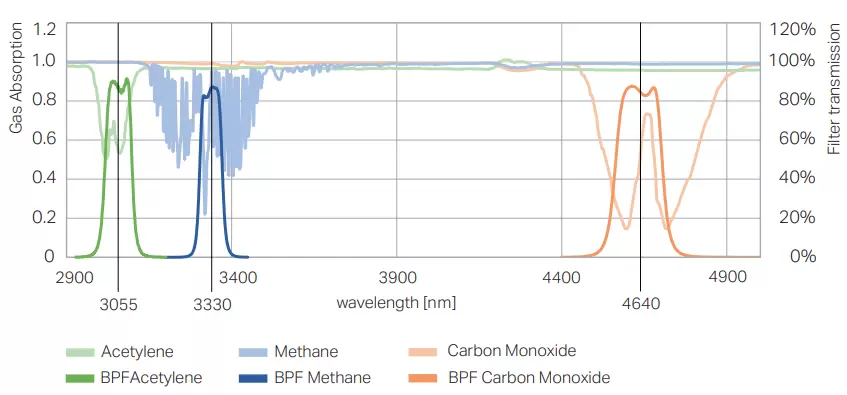
Methane (CH₄) 3330 nm 70 nm
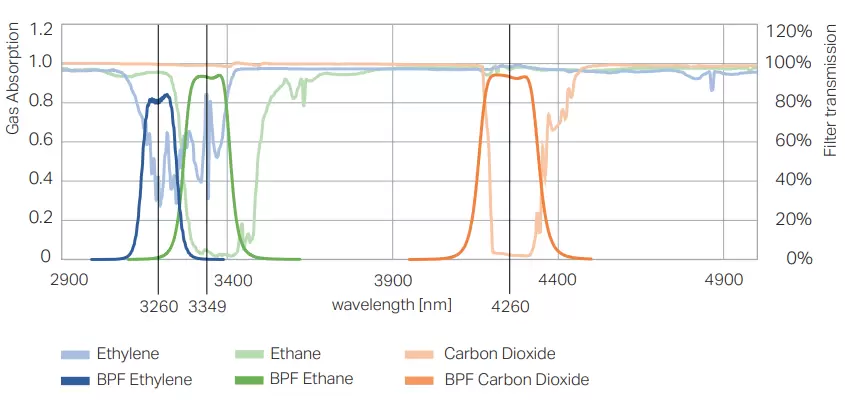
Ethane (C2H₆) 3349 nm 147 nm
Ethylene (C2H₄) 3260 nm 110 nm
Acetylene (C2H₂) 3055 nm 85 nm
Carbon Monoxide (CO) 4640 nm 147 nm
Carbon Dioxide (CO₂) 4260 nm 185 nm


A properly calibrated NDIR sensor can provide a quantitative measure of the concentration of fault gases.

Materion Balzers Optics offers bandpass filter sets custom-tailored to the absorption band for the individual fault gases. Filters must have a narrow bandwidth in order to accurately measure gas concentration with a NDIR sensor.

Materion routinely produces narrowband filters to measure ethylene, acetylene, carbon monoxide and carbon dioxide. The combined concentrations of methane and ethane are measured by the same filters since their Centre Wavelengths are closely spaced.

Gas Absorption Fingerprint of Acetylene , Methane and Carbon Monoxide

Gas Absorption Fingerprint of Acetylene , Methane and Carbon Monoxide

Gas Absorption Fingerprint of Ethylene , Ethane and Carbon Dioxide

Gas Absorption Fingerprint of Ethylene , Ethane and Carbon Dioxide


Summary


Materion Balzers Optics leads the way in precise Dissolved Gas Analysis (DGA) with our advanced optical filters. Our filters excel in quantitative measurements, offering accuracy down to parts per million (ppm) in a properly calibrated non-dispersive IR sensor. When combined with sophisticated multi-variate statistical methods, they redefine transformer diagnostics by providing nuanced insights into fault gases.

Our optical filters establish a new standard in precision, enabling optimized maintenance strategies and reinforcing our commitment to technological excellence in Dissolved Gas Analysis.

Explore the possibilities of enhanced Dissolved Gas Analysis (DGA) with Materion Balzers Optics. For more information on our advanced optical filters, or if you're seeking reliable suppliers of gas detectors and sensor systems for online, real-time DGA solutions, get in touch with us.

We specialize in delivering MWIR filters to enable precision and reliability to transformer diagnostics.

Reach out today to unlock the full potential of cutting-edge technology and take your gas analysis to the next level.


Copyright: The information provided herein is correct to the best of Materion Balzers Optics knowledge. No liability for any errors, facts or opinions is accepted. Materion Balzers Optics disclaims any liability for incidental or consequential damages, which may result from the use of the product that are beyond its control. Nothing contained herein is to be considered as permission or a recommendation to infringe any patent or any other intellectual property right. All information contained herein is subject to change without notice. www.materionbalzersoptics.com