arrow

Monitoring Water Quality

1/2

Optics Balzers Logo
Monitoring Water Quality

(image source: CSEM)


Application Note
OBA 001 AE (1512-1)

Optics Balzers AG

Neugrüt 35
LI-9496 Balzers
T +423 388 9200
www.opticsbalzers.com

Optics Balzers has been the innovative and independent industry partner for the development and production of coated optical components and subassemblies for more than 70 years.

Monitoring Water Quality – here and now


Authors: Florian Kehl, Optics Balzers AG, Turn on Javascript!
Maurus Tschirky, CSEM


To analyze the quality of aqueous solutions today, you need to take your sample and send it to the laboratory. The results will be available days later. Is there any faster way? – Yes, there is. A new development allows this analysis to be carried out where you want and in almost real-time. A label-free optical biosensor measures the presence of desired analytes and the instrument makes the data available online. Such continuous monitoring provides both significant advantages in Quality Control as well as cost savings due to controlled amounts of additives required for the water treatment.

As for the pharmaceutical industry, food and feed production, Medtech, Biotech, Chemical industry and in Research – the quality of aqueous solutions is vital in many different markets and for countless applications. Be it for processes themselves or in order to purge and clean the facilities, contaminations and residuals of toxins, pesticides are pharmaceuticals are of highest interest for quality control and to fulfill environmental regulations. What holds true for the inlet is also valid for the outlet – in fact, only a differential measurement before and after the treatment allows the conclusion on the elimination and therefore to control the use of the costly additives. Furthermore, varying quality in process water might influence attained results in research and, in case of pharmaceuticals or food production, even lead to health issues.

While most people in charge are conceivably aware of the implications and consequences and therefore perform periodical sample testing, a continuous and consistent monitoring is rarely seen these days. The major reasons are missing methods and instrumentation. Regarding swiftness, flexibility and mobility, the methods in place still leave a great deal left to be desired. In fact, several days between sampling and reception of results are the reality.
Prompt results: Innovative concept for water analysis
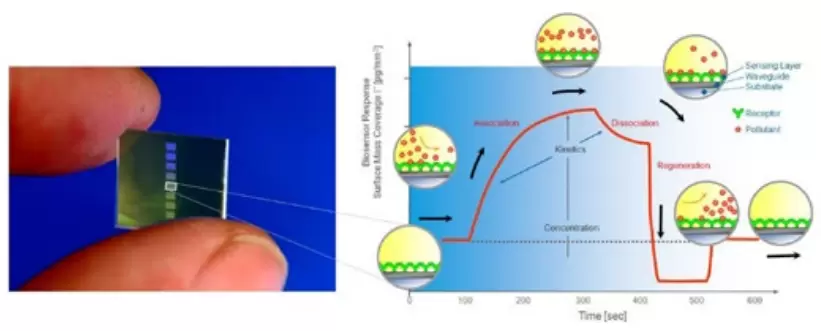
A new technology, jointly developed with academic and industrial partners, including Optics Balzers AG and CSEM, makes a highly sensitive analysis of water in almost real-time possible. With our technology we can now face the widely acknowledged necessity of timely results. But how does it work? Aqueous solutions are often polluted with a large variety of contaminants, such as pesticides, preservatives, components of printing inks, residuals of pharmaceuticals. All of these can impact human and animal organisms and lead to serious health issues. Such harmful substances find their way into organisms through food and drinking water. Oftentimes, detrimental interference with the hormonal system includes the possibility of harming embryos, causing infertility or provokes tumors. Biosensors offer the means to trace exactly these substances. Their presence is detected by measuring the binding events of the contaminants in the aqueous solution. The surface of a waveguide is functionalized with the respective receptors to enable the binding events. The measurable effect comes from the change of the optical properties of the surface of the waveguide. A truly disruptive advantage arises out of the time-resolved recording of the binding events. The kinetics allow for sorting out not-intended random events.

Contaminants in water samples are detected by analyzing the changes of the optical properties due to binding events on top of a waveguide.

Contaminants in water samples are detected by analyzing the changes of the optical properties due to binding events on top of a waveguide. (image source: CSEM)


Copyright: The information provided herein is correct to the best of Optics Balzers knowledge. No liability for any errors, facts or opinions is accepted. Optics Balzers disclaims any liability for incidental or consequential damages, which may result from the use of the product that are beyond its control. Nothing contained herein is to be considered as permission or a recommendation to infringe any patent or any other intellectual property right. All information contained herein is subject to change without notice. www.opticsbalzers.com


2/2

Optics Balzers Logo

Top flexibility: Monitoring in the open country
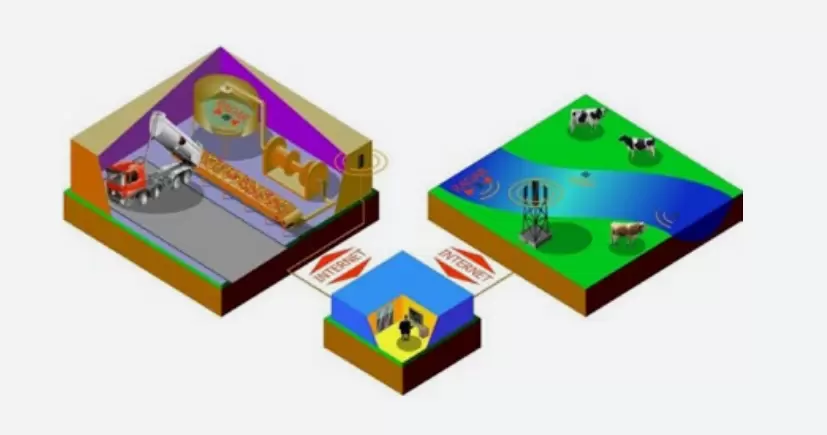
Among the biggest advantages is the online-availability of the entire information, where the instrument is wirelessly connected to the control computer. Monitoring in open field or remote locations is therefore made possible. One of the novel features of the instrument is the 8-channel microfluidic. It is capable of tracing multiple analytes within a single setup. On top of that, the method itself manages without markers and is therefore label-free. All this reduces the time of the investigation significantly, while making the employment easier in general. While analytical laboratories usually need to add markers, such practice cannot be applied out in the open country. The resulting continuous monitoring provides by far more information than the standard endpoint-analysis.

Cost savings through controlled use of additives
The presented novel method allows for a controlled usage of expensive additives, such as ozone and activated carbon. Regulatory limiting values must be kept, while optimizing the use of the additives. Companies and Research Labs using the instrument both measure up ecological as well as economical standards.

Conclusion
In many different industries and application the quality of water or aqueous solutions used in or resulting from processes play vital roles. Novel technologies now enable an easy-to-use, fully integrated online monitoring of water quality in almost real-time. Where ever you would like to measure for quality control or environmental issues, the novel instrument provides you with the means to do so.

Planar waveguide (PWG) chips fabricated at Optics Balzers AG are the key enabling technology that led to this technological advancement. For more information on the PWGs refer to our corporate website and the data sheet OBA 017 PE – Gratings & Planar Waveguides – Sub-Micron Diffractive Structures and High Index Coatings.

The data of the biosensor is available in almost real-time, making the use of the instrument out in the country possible.

The data of the biosensor is available in almost real-time, making the use of the instrument out in the country possible. (image source: CSEM)

Optics Balzers AG together with CSEM

(image source: CSEM)


Summary


Optics Balzers AG together with CSEM

Are proudly announcing a prototype to monitor toxins, harmful substances, proteins, DNA, RNA EDCs (Endocrine Disruptive Compounds) and other molecules in aqueous solutions. This innovative, novel biosensor-technology of the Swiss experts is called ARGOS (Angle Interrogated Optical Sensor). It enables online monitoring in almost realtime and remains flexible enough for a wide range of applications. ARGOS combines label-free measurement, automated sample preparation and a wireless communication system to a fully autonomous instrument for facilities and in the open country.


Copyright: The information provided herein is correct to the best of Optics Balzers knowledge. No liability for any errors, facts or opinions is accepted. Optics Balzers disclaims any liability for incidental or consequential damages, which may result from the use of the product that are beyond its control. Nothing contained herein is to be considered as permission or a recommendation to infringe any patent or any other intellectual property right. All information contained herein is subject to change without notice. www.opticsbalzers.com