1/3
Application Note
MBO 003 AD (2401-1)
Optics Balzers AG
Neugrüt 35
LI-9496 Balzers
T +423 388 9200
www.materionbalzersoptics.com
Materion Balzers Optics has been the innovative and independent industry partner for the development and production of coated optical components and subassemblies for more than 70 years.
Author: Elmar Elbinger, Business Development Manager Turn on Javascript!
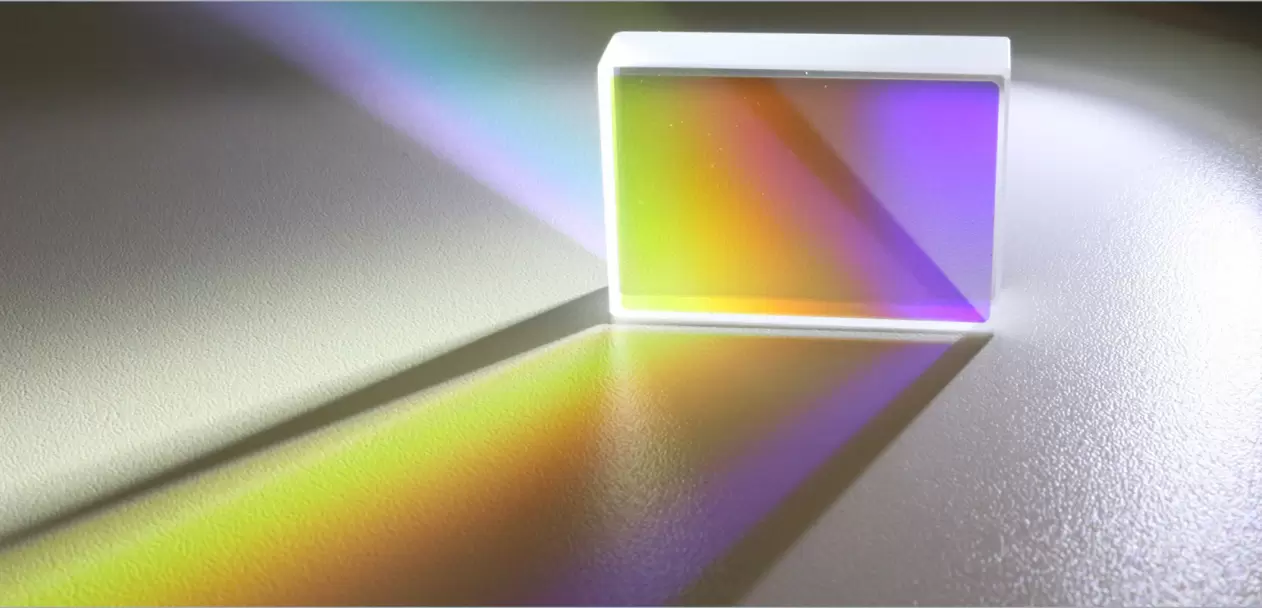
Linear Variable Filters are an innovative and flexible solution for the technological demands of the fields of diagnostics and analysis.
The current SARS-CoV-2 pandemic has made it abundantly clear how important it is to determine analytical laboratory values quickly and accurately. However, even in the days before the pandemic erupted, there was already a strong focus on laboratory equipment and processes. These should always be multifunctional and flexible, as a large amount of data must be collected in a short time. The results must then be analysed precisely to ensure accuracy and reliability.
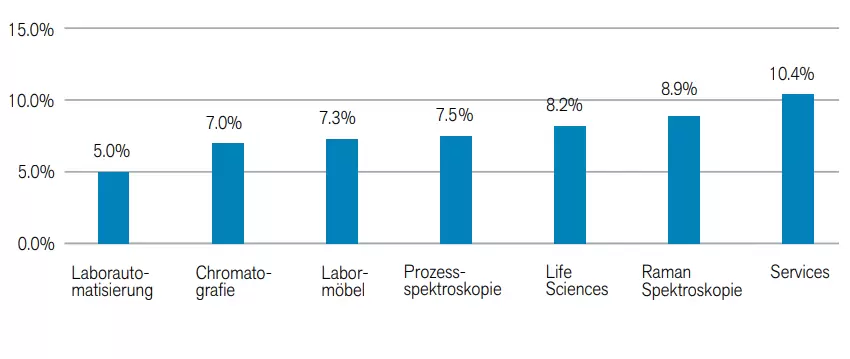
Optical methods for information acquisition, e.g. based on spectroscopy, are indispensable in laboratory equipment. Fluorescence techniques such as labelling in marker technology are just one example of the integration of optical components in process analysis. According to the 2019 Trend Report of the Spectaris Association, the annual growth rate for process spectroscopy alone is approximately 7.5% (Figure 1).
A decisive factor in the success of this division is the increasing segmentation of products. This is a huge advantage, as it optimizes the accuracy of the data obtained. However, it is precisely this segmentation and the associated specialization of laboratory equipment that poses a crucial problem in terms of cost structure. Despite the desire for diversity, the components used must allow for a certain flexibility. Only then is it possible to offer attractive and innovative solutions both in terms of technology and cost.
Product description
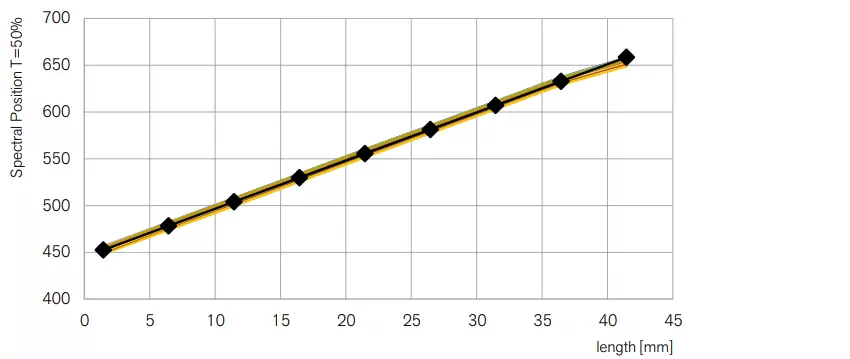
Materion Balzers Optics, as a globally recognized supplier of innovative coating solutions, has developed specific solutions for this market. For example, Linear Variable Filters (LVF) for use in laboratory analysis systems. Thanks to a special coating technology, these filters have a precisely defined spectral response. Running parallel to the length of the filter, the edge position of the filter range varies, and the gradient can be adapted to customer requirements (Figure 2).
As seen in Figure 2 the exact position of the individual filter edge was determined over the substrate length. The shown curves show the high reproducibility of the edge position on several filters.
Fig. 1: Projected annual growth rate of selected segments
Fig. 2: Reproducibility of the edge position
Copyright: The information provided herein is correct to the best of Materion Balzers Optics knowledge. No liability for any errors, facts or opinions is accepted. Materion Balzers Optics disclaims any liability for incidental or consequential damages, which may result from the use of the product that are beyond its control. Nothing contained herein is to be considered as permission or a recommendation to infringe any patent or any other intellectual property right. All information contained herein is subject to change without notice. www.materionbalzersoptics.com
2/3
Fig. 3: Individual edge positions in the spectral range and their transmission value
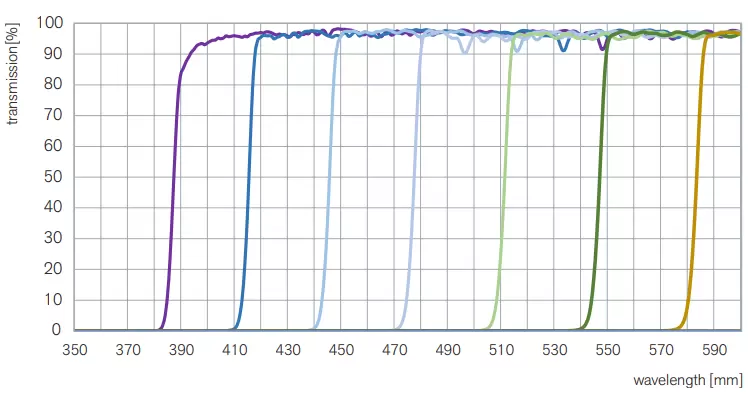
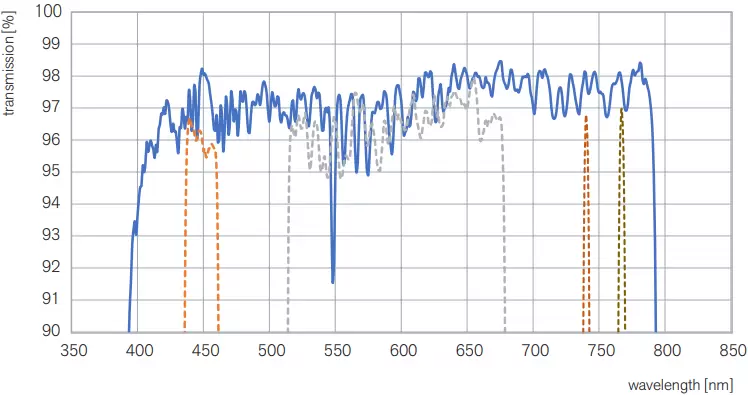
Fig. 4: High transmission level >97% for different filter configurations
The figure on the left (Figure 3) shows the individual edge positions within the spectral range and their transmittance values.
LVFs have various features that can be customized and optimized according to the application. Materion Balzers Optics offers various LVFs in the spectrum, from 300nm to the near-infrared range. The adjustable edge position of the transmission band can be adapted to the respective measurement task. Since the gradient has an extremely high linearity, users can utilize the new measuring range without any complex calibrations. Typically, gradients for filter types in the Life Sciences range between 5 nm/mm and 10 nm/mm. These values are suitable for filters used in diagnostics and analysis, technical processes, and microbiology. Gradients of up to 90 nm/mm are used for applications in imaging sensors.
The filters produced by Materion Balzers Optics are manufactured using dielectric sputter technology instead of conventional coating processes. This means low absorption is a significant feature of these filters, increasing laser power in optical systems. Furthermore, the sputter process also means outstanding spectral transmission properties (see Figure 4). Depending on the wavelength, transmissions of up to 97% can be achieved. In addition, filters manufactured using sputter technology have excellent long-term stability.
In order to offer a successful technological solution, especially in the field of process spectroscopy, the steepness of the spectral filter edges is essential. Only this guarantees a precise separation of the optical signals. Filters produced by Materion Balzers Optics achieve an edge steepness in the nanometer range of T90% to T0.1%. In addition, optical filter blocking is available in the wider spectral range. This guarantees the reliable suppression of unwanted signals and improves the signal-to-noise ratio.

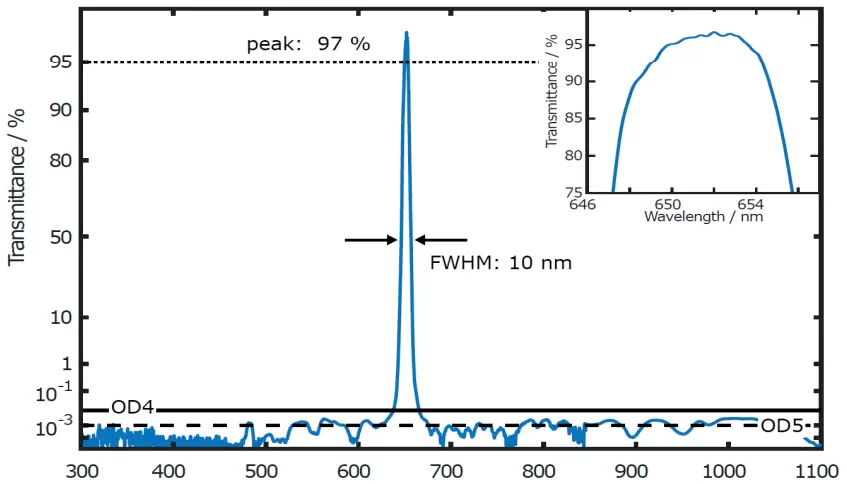
Fig. 5: Spectral range with absolut blocking >OD4 and average blocking >OD5
The curve in Figure 5 shows the absolute blocking of up to OD 4. This filter combination can even block up to OD 5. These values are achieved because a high-energy plasma is created in the sputtering process using a reactive gas supply. These high levels of energy enable the formation of a homogeneous and particularly compact layer structure.
Operating principle
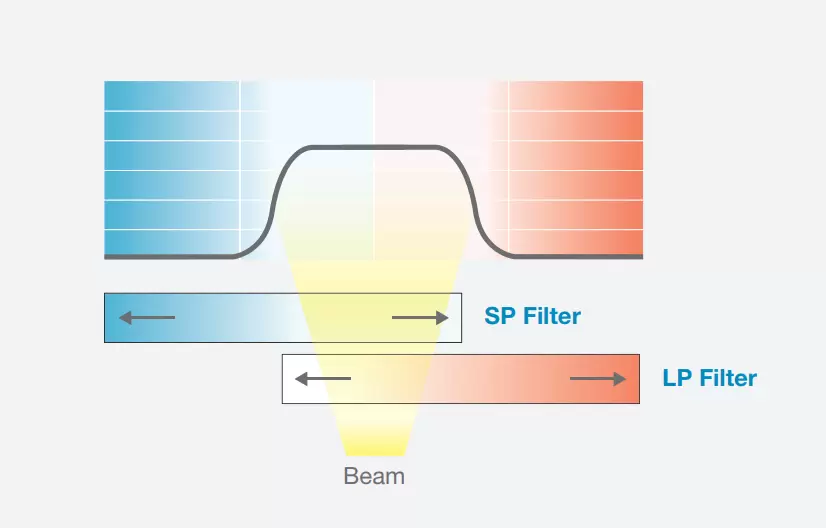
A combination of only two Linear Variable Filters (a Long Pass Filter (LP) and a Short Pass Filter (SP), allows for individual adjustments of the desired performance at any time.
A simple shifting of the filters on one axis, shown in Figure 6, allows the realization of any bandpass filter in the spectral range of the filters. If both filters are moved independently of each other on one axis, both the bandwidth and the spectral position of the resulting bandpass can be adjusted and varied at any time.
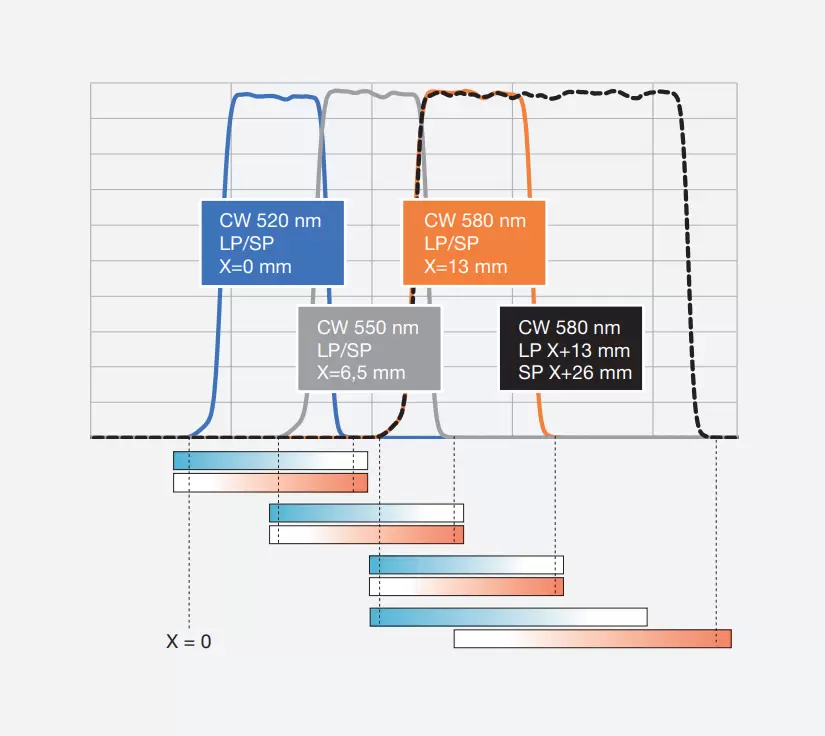
The detailed operating principle for both bandpass filters is shown in Figure 7 (Bandpass shift), based on the production measurement curves of a filter combination for 450–700 nm.
Fig. 6: LVF based on the combination of LP-filter and SP-filter
Copyright: The information provided herein is correct to the best of Materion Balzers Optics knowledge. No liability for any errors, facts or opinions is accepted. Materion Balzers Optics disclaims any liability for incidental or consequential damages, which may result from the use of the product that are beyond its control. Nothing contained herein is to be considered as permission or a recommendation to infringe any patent or any other intellectual property right. All information contained herein is subject to change without notice. www.materionbalzersoptics.com
3/3
Both filters are shifted in parallel by 6.5 mm to the imaginary signal source (x=0). The entire bandpass range, with a transmission of >95%, is shifted by about 30 nm (see: CW550 nm x= +6.5 mm) into the longwave range. A further parallel shift to x=13 mm also moves the band-pass range by an additional 30 nm, into the long-wave range (see: CW580 nm x= +13 mm). If the two filters are not shifted in line with each other, then the bandwidth of the pass band can be adjusted, as shown in the example "LP x= +13 mm; SP x= +26 mm". The combination of only two filters to form a bandpass filter that can be adjusted and tuned as desired represents an inexpensive alternative to buying a large number of individual filters. LVF therefore appears to be the method of choice for diagnostic systems that require a particular degree of flexibility.
Fig. 7: Bandpass filter adjustment for tuning of different filter characteristics
In addition to the above described field of application in diagnostic spectroscopy, there is also the possibility of using Linear Variable Filters in hyperspectral imaging (HSI). Linear Variable Filters components are gradually being used as wavelength selectors, sorting filters in lattice-based systems, in purely filterbased spectrometers and even in the aerospace sector. Certain systems require light and compact instruments, whereas others have spectral requirements such as edge position and steepness, as well as absorption and blocking, that are crucial for signal detection.
The discussion about the future of work is in full swing. Digital interfaces, smart devices and the integration of robotic solutions are about to take off. In view of the increasing demand for flexible and fast solutions that meet market requirements, innovative solutions are needed. The close cooperation of device manufacturers and technology providers of individual components is a decisive advantage for successful operation in tomorrow´s market.
Copyright: The information provided herein is correct to the best of Materion Balzers Optics knowledge. No liability for any errors, facts or opinions is accepted. Materion Balzers Optics disclaims any liability for incidental or consequential damages, which may result from the use of the product that are beyond its control. Nothing contained herein is to be considered as permission or a recommendation to infringe any patent or any other intellectual property right. All information contained herein is subject to change without notice. www.materionbalzersoptics.com