1/5
Application Note
MBO-AE-007 (2506-1)
Optics Balzers AG
Neugrüt 35
LI-9496 Balzers
T +423 388 9200
www.materionbalzersoptics.com
Materion Balzers Optics is a global leader in optical thin film coating solutions.
We are the preferred partner for providing innovative optical coatings and solutions for over 70 years.
Author: Guglielmo Cappellari, Customer Project Manager
Turn on Javascript!
The automotive industry is undergoing a profound transformation, driven by the increasing demand for autonomous driving and advanced safety features. Central to this evolution is the integration of sophisticated sensor technologies, particularly Light Detection and Ranging (LiDAR) systems. LiDAR technology employs laser beams to measure distances and generate detailed, three-dimensional maps of a vehicle's environment. Materion Balzers Optics enables an improvement of efficiency of the LiDAR systems by offering two key optical components, the Polygon Mirror and the Cover Window.
LiDAR systems are revolutionizing the automotive market by enabling advanced driver-assistance systems (ADAS) and autonomous vehicles. These systems use laser beams to measure distances by emitting pulses of light and analyzing the time it takes for the light to return after reflecting off objects. This process creates a detailed 3D map of the vehicle's surroundings, allowing for precise object detection, ranging, and classification.
In automotive applications, LiDAR enhances safety by providing real-time data on the environment, including the position of other vehicles, pedestrians, and obstacles. This information is crucial for features such as adaptive cruise control, lane-keeping assistance, and automated emergency braking. Moreover, LiDAR's high-resolution imaging capabilities allow for accurate perception in various weather conditions and lighting scenarios, making it a reliable choice for autonomous driving.
As the automotive industry continues to evolve towards fully autonomous vehicles, the integration of LiDAR technology is essential for achieving higher levels of safety and efficiency on the roads. Its ability to complement other sensors, such as cameras and radar, creates a robust perception system that enhances overall vehicle intelligence.
LiDAR systems in the automotive market utilize several key technologies, each with its own advantages and applications. The most common
LiDAR technologies include:
Each of these technologies plays a crucial role in advancing automotive safety and autonomy, contributing to the development of smarter, more reliable vehicles. As the industry progresses, ongoing innovations in LiDAR technology will continue to enhance the capabilities of autonomous driving systems.
Copyright: The information provided herein is correct to the best of Materion Balzers Optics knowledge. No liability for any errors, facts or opinions is accepted. Materion Balzers Optics disclaims any liability for incidental or consequential damages, which may result from the use of the product that are beyond its control. Nothing contained herein is to be considered as permission or a recommendation to infringe any patent or any other intellectual property right. All information contained herein is subject to change without notice. www.materionbalzersoptics.com
2/5
Coated optical components, such as polygon mirrors and cover windows, are integral to the functionality of automotive LiDAR systems, which are essential for enabling precise distance measurement and environmental mapping in autonomous vehicles. However, these components face a myriad of technical challenges that can significantly impact their performance, reliability, and longevity.
Surface Accuracy of Polygon Mirrors
The surface accuracy of polygon mirrors is critical for the performance of LiDAR systems. These mirrors must have exceptionally precise geometries to ensure that the reflected laser beams maintain their intended paths. Any deviations in surface flatness or curvature can lead to scattering or distortion of the laser light, resulting in inaccurate distance measurements and degraded image quality. Achieving the required surface accuracy often involves advanced manufacturing techniques, such as precision machining and optical polishing, which can be both time-consuming and costly. Additionally, the materials used must be carefully selected to minimize thermal expansion and maintain stability under varying environmental conditions. Regular quality control and testing are essential to ensure that each mirror meets stringent specifications, as even minor imperfections can significantly impact the overall system performance.
Durability of Coatings
One of the primary challenges is the durability of optical coatings. Automotive environments are notoriously harsh, exposing LiDAR systems to extreme
temperature fluctuations, humidity, and UV radiation. The coatings applied
to optical components must be robust enough to withstand these conditions
without degrading. For instance, anti-reflective coatings can suffer from
delamination or scratching, leading to reduced optical performance. Engineers must select materials that not only provide the desired optical properties but also exhibit high resistance to environmental stressors.
Abrasion and Chemical Resistance
In addition to environmental factors, the coatings must also resist abrasion from dust, dirt, and other particulates that can accumulate on the surface of optical components. This is particularly critical for cover windows, which are often exposed to the elements. The choice of coating materials and application techniques must ensure that the surface remains smooth and clear over time. Furthermore, exposure to automotive fluids, such as oils and cleaning agents, can compromise the integrity of the coatings, necessitating the development of chemically resistant materials.
Heating Function for Cover Windows
An essential consideration for cover windows in automotive LiDAR systems is the need for a heating function. In cold weather conditions, ice and snow can accumulate on the cover window, obstructing the optical path and
impairing the system's performance. To mitigate this issue, many designs incorporate heating elements within or beneath the cover window. These heating systems must be carefully engineered to provide uniform heat distribution without causing thermal distortion of the optical components. The challenge lies in balancing the heating requirements with energy efficiency, as excessive power consumption can impact the vehicle's overall energy management.
Dark-Color for Cover Windows
LiDAR sensors typically feature black or dark-colored windows to reduce reflections and glare from ambient light, which can disrupt accurate distance detection. This is particularly crucial in outdoor settings, where sunlight can cause reflections that confuse the sensor. However, achieving a uniform black finish while maintaining high transmittance for infrared wavelengths presents a challenge. Manufacturers must balance aesthetics and functionality to ensure optimal sensor performance in various lighting conditions.

LiDAR Polygon Mirrors
LiDAR polygon mirrors are a crucial component for mechanical scanning in LiDAR systems (Fig. 1). Key attributes such as sensing range, number of beam lines, resolution, repeatability, and scan angle significantly impact the performance of these mirrors. Materion Balzers Optics offers polygon mirror products that deliver optimal scanning performance for LiDAR systems.
Our advanced coating technology and integration solutions enable LiDAR systems to achieve exceptional optical quality and durability. The coatings are specifically optimized for large angles of incidence (AOI), providing excellent reflectivity that enhances the LiDAR's field of view (FOV) and detection distance (Fig. 2, Fig. 3). Additionally, Materion Balzers Optics extends its offerings with flexible integration solutions, including motor assemblies and technologies that accommodate various substrate geometries and materials, allowing for customized designs tailored to specific needs.
Wavelength range 840 - 1600nm: AOI=12 - 80°
Reflectance
Rs>= 97 % in the 880 - 940nm at AOI=12 - 80°
Rp>= 97 % in the 880 - 940nm at AOI=12 - 80°
Rs>= 97 % in the 1500 - 1600nm at AOI=12 - 80°
Rp>= 97 % in the 1500 - 1600nm at AOI=12 - 80°
Surface Accuracy
PV<l.5). @633nm
Profile
Appearance tolerance ±0.lmm
Parallelism <0.02mm
Perpendicularity <0.02mm
Dimensions
Customized, typical 50 x 50 x 50mm
Environmental Durability
High temp: -40°C - 95°C 20minutes/cycle for 200 cycles
Thermal Shock: +85°C, RH: 85 - 95% for 24 hours
Humidity: +40°C, RH: 100% for 16 days
Salt spray(Fog): 35°C ±2°C 24h,4.5%NaCl
Fig. 2. Polygon Mirror typical data
Copyright: The information provided herein is correct to the best of Materion Balzers Optics knowledge. No liability for any errors, facts or opinions is accepted. Materion Balzers Optics disclaims any liability for incidental or consequential damages, which may result from the use of the product that are beyond its control. Nothing contained herein is to be considered as permission or a recommendation to infringe any patent or any other intellectual property right. All information contained herein is subject to change without notice. www.materionbalzersoptics.com
3/5
Fig. 3. Polygon Mirror typical data
LiDAR Cover Windows
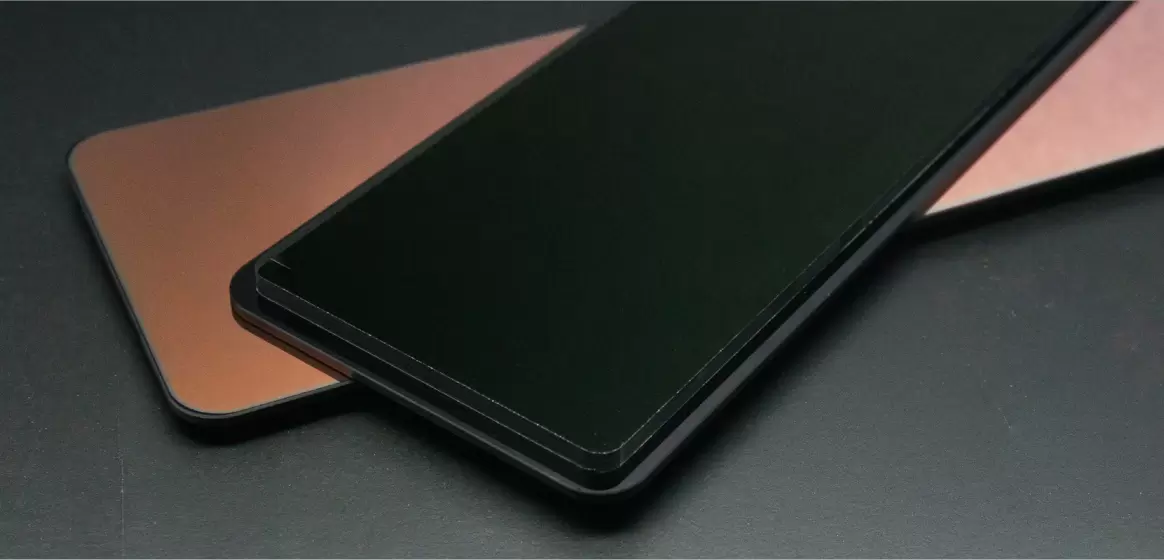
Materion Balzers Optics LiDAR cover windows offer exceptional protection for LiDAR systems against environmental exposure while simultaneously optimizing efficiency in both light transmission and thermal performance (Fig. 4). We provide customized color solutions (neutral color, black color) and achieve superior transmittance values for large angles of
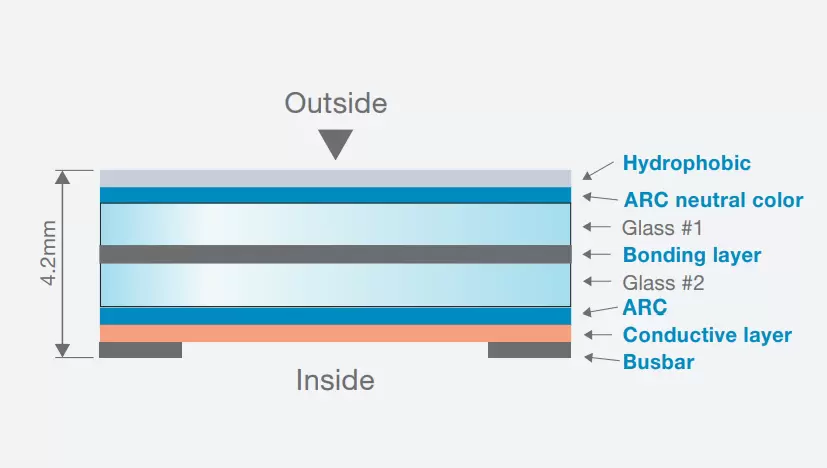
Schematic of LiDAR Cover Window for LiDAR Sensor – 2.75mm Glass 1 with AR + bonding + 1.1mm Glass 2 with AR + ITO + Busbar

incidence (AOI), along with integrated anti-fog and easy-to-clean (hydrophobic) features (Fig. 5, Fig. 6, Fig. 7). Our technology platform is designed to accommodate a variety of NIR wavelength (840nm – 1600nm), substrate geometries and materials, empowering window designers to create functional and aesthetically pleasing designs that seamlessly integrate into vehicles. This ensures that LiDAR systems maintain peak performance in diverse conditions, enhancing overall reliability and effectiveness.
Outer side

Neutral with AR Coating
Inner side

AR Coating + ITO and Busbar
Copyright: The information provided herein is correct to the best of Materion Balzers Optics knowledge. No liability for any errors, facts or opinions is accepted. Materion Balzers Optics disclaims any liability for incidental or consequential damages, which may result from the use of the product that are beyond its control. Nothing contained herein is to be considered as permission or a recommendation to infringe any patent or any other intellectual property right. All information contained herein is subject to change without notice. www.materionbalzersoptics.com
4/5
Coating Spectrum AR
T > 99 % in the laser band at normal angle incident
Ts > 94 %, Tp > 94% in the laser band at AOI = 60°
T < 2% in the visible range
R < 0.25% in the laser band for normal angle incident
TopFlex™ (Easy-to-clean)
AR coating with TopFlex™ coating
Wetting angle = 120°
Fluids and dirt do not adhere on the surface
Size
Can be customized, up to 300mm x 300mm
Heating Solution (Optional)
ITO or heating wire, etc.
Fig. 4. Cover Window typical data
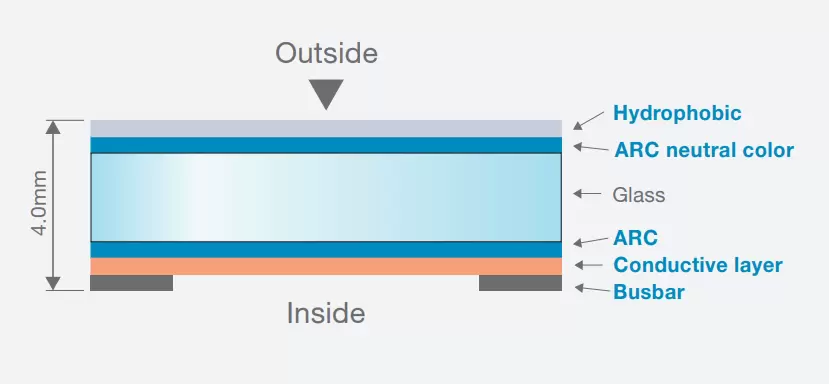
Fig. 5. Cover Window typical data
Cover Window Solution #1
Single Structure with Anti-Fog/Defrost (Fig. 6)
Single structure + conductive layer heating
| Electrical performance | Heat performance | ||||||
|---|---|---|---|---|---|---|---|
| Sheet Resistance (Ω/☐) |
Busbar resistance (Ω) |
Resistance Between Pad (Ω) |
0 Min Temp (°C) |
2 Min Temp (°C) |
5 Min Temp (°C) |
Delta T in 5 Min (°C) |
Heat Uniformity |
| 73.9 | 0.7 | 26.0 | 25.2 | 40.2 | 47.4 | 22.3 | 15% |
Example: 120 x 40mm window heating performance
| % | AOI | wl | wl | ||
|---|---|---|---|---|---|
| Ts | > | 96 | 0 | 870 | 950 |
| Tp | > | 96 | 0 | 870 | 950 |
| Ts | > | 96 | 30 | 870 | 950 |
| Tp | > | 96 | 30 | 870 | 950 |
| Ts | > | 91 | 60 | 870 | 950 |
| Tp | > | 91 | 60 | 870 | 950 |
| Rsavg | < | 3 | 30 | 870 | 950 |
| Rpavg | < | 3 | 30 | 870 | 950 |
| Rsavg | < | 8 | 60 | 870 | 950 |
| Rpavg | < | 8 | 60 | 870 | 950 |
Transmittance including conductive layer: Total for Window@905nm
>> Color abs (a*) <3, abs (b*) <3 from 0 to 60 degree
| % | AOI | wl | wl | ||
|---|---|---|---|---|---|
| Ts | > | 98 | 0 | 870 | 950 |
| Tp | > | 98 | 0 | 870 | 950 |
| Ts | > | 98 | 30 | 870 | 950 |
| Tp | > | 96 | 30 | 870 | 950 |
| Ts | > | 93 | 60 | 870 | 950 |
| Tp | > | 93 | 60 | 870 | 950 |
| Rsavg | < | 2 | 30 | 870 | 950 |
| Rpavg | < | 2 | 30 | 870 | 950 |
| Rsavg | < | 6 | 60 | 870 | 950 |
| Rpavg | < | 6 | 60 | 870 | 950 |
Transmittance without conductive layer: Total for Window@905nm
>> Color abs (a*) <3, abs (b*) <3 from 0 to 60 degree
Copyright: The information provided herein is correct to the best of Materion Balzers Optics knowledge. No liability for any errors, facts or opinions is accepted. Materion Balzers Optics disclaims any liability for incidental or consequential damages, which may result from the use of the product that are beyond its control. Nothing contained herein is to be considered as permission or a recommendation to infringe any patent or any other intellectual property right. All information contained herein is subject to change without notice. www.materionbalzersoptics.com
5/5
Cover Window Solution #2
Sandwich Structure with Anti-Fog/Defrost (Fig. 7)
Sandwich structure + conductive layer heating
| Electrical performance | Heat performance | ||||||
|---|---|---|---|---|---|---|---|
| Sheet Resistance (Ω/☐) |
Busbar resistance (Ω) |
Resistance Between Pad (Ω) |
0 Min Temp (°C) |
2 Min Temp (°C) |
5 Min Temp (°C) |
Delta T in 5 Min (°C) |
Heat Uniformity |
| 74.0 | 0.7 | 26.0 | 25.2 | 40.2 | 47.4 | 22.3 | 15% |
Example: 120 x 40mm window heating performance
| % | AOI | wl | wl | ||
|---|---|---|---|---|---|
| Ts | > | 95 | 0 | 870 | 950 |
| Tp | > | 95 | 0 | 870 | 950 |
| Ts | > | 95 | 30 | 870 | 950 |
| Tp | > | 95 | 30 | 870 | 950 |
| Ts | > | 87 | 60 | 870 | 950 |
| Tp | > | 87 | 60 | 870 | 950 |
| Rsavg | < | 3 | 30 | 870 | 950 |
| Rpavg | < | 3 | 30 | 870 | 950 |
| Rsavg | < | 9 | 60 | 870 | 950 |
| Rpavg | < | 9 | 60 | 870 | 950 |
Transmittance including conductive layer: Total for Window@905nm
>> Color abs (a*) <3, abs (b*) <3 from 0 to 60 degree
| % | AOI | wl | wl | ||
|---|---|---|---|---|---|
| Ts | > | 97 | 0 | 870 | 950 |
| Tp | > | 97 | 0 | 870 | 950 |
| Ts | > | 97 | 30 | 870 | 950 |
| Tp | > | 97 | 30 | 870 | 950 |
| Ts | > | 89 | 60 | 870 | 950 |
| Tp | > | 89 | 60 | 870 | 950 |
| Rsavg | < | 2 | 30 | 870 | 950 |
| Rpavg | < | 2 | 30 | 870 | 950 |
| Rsavg | < | 7 | 60 | 870 | 950 |
| Rpavg | < | 7 | 60 | 870 | 950 |
Transmittance without conductive layer: Total for Window@905nm
>> Color abs (a*) <3, abs (b*) <3 from 0 to 60 degree
Autonomous driving is only achievable through the seamless integration of various systems, including LiDAR, cameras, radar, and ultrasound. In the future, LiDAR systems are set to play an increasingly vital role in this technology landscape. To ensure that LiDAR systems operate efficiently, reliably, and are suitable for mass production, it is essential to optimize the key components – polygon mirrors and cover windows – for both cost and technical specifications. Materion Balzers Optics provides these two critical components from a single source, consistently focusing on optimizing cost-performance ratios. By prioritizing innovation and quality, we aim to support the advancement of autonomous driving technologies and enhance overall vehicle safety and performance.
Copyright: The information provided herein is correct to the best of Materion Balzers Optics knowledge. No liability for any errors, facts or opinions is accepted. Materion Balzers Optics disclaims any liability for incidental or consequential damages, which may result from the use of the product that are beyond its control. Nothing contained herein is to be considered as permission or a recommendation to infringe any patent or any other intellectual property right. All information contained herein is subject to change without notice. www.materionbalzersoptics.com